Friday, September 29, 2023

Exhibit: Something Old, Something New: Wedding Fashions and Traditions at the Museum of Fine Arts, Boston


I recently visited the MFA Boston to view ‘Something Old, Something New: Wedding Fashions and Traditions’ curated by Theo Tyson (@ms_theotyson). Tyson (she/they) is the Penny Vinik Curator of Fashion Arts, Museum of Fine Arts, Boston, who invites conversations about the sociocultural implications of race, gender, identity, and sexuality through a lens of fashion, art, and culture. [1]


Designer Bob Mackie's 1980s beaded wedding ensemble 

Wedding dresses (left to right) Bob Mackie, Arnold Scaasi and Geoffrey Beene


This single gallery installation is as joyful and engaging as opening, unpacking and savoring a long-closed trousseau or family trunk, redolent of memories, traditions, hopes & dreams— embraced across cultures and over time. Thoughtful and thought provoking; insightful and in-depth, there is something to appeal to every visitor from the glamorous gowns and sparkling jewelry to the accessories and informal family photos--even the soundtrack will have you humming along and reminiscing about these special occasions as a participant or guest. 

It is through these family snapshots that the viewer is reminded of the inclusivity of the ceremony and the celebration -- the desire to share this bond with family and/or friends.


And in these unscripted moments—some ebullient, some contemplative—captured in the family-style photo frame - that will resonate with many visitors. 

The text is tightly written and is peppered with questions for visitors to consider, which shifts the mindset from passive to active engagement. For example, a case is dedicated to the display delicate orange blossom headpieces. The curator reminds the viewer that the symbolism of this delicate flower reaches far back in time, long before Queen Victoria: 

"Orange blossoms symbolize virtue, love, and fertility, and have been associated with weddings for centuries. They have been used in China, India, and Persia to represent purity, innocence, and chastity...You can even see the dainty blooms on the ceremonial brooms of African-Americans that engaged in the "jumping of the broom" tradition that originated during chattel slavery when enslaved peoples were not permitted proper nuptials."

There is much to experience when you visit -- but hurry the exhibition closes on October 1st.


1. For more information on Theo Tyson
https://www.theotyson.com/

Monday, September 12, 2022

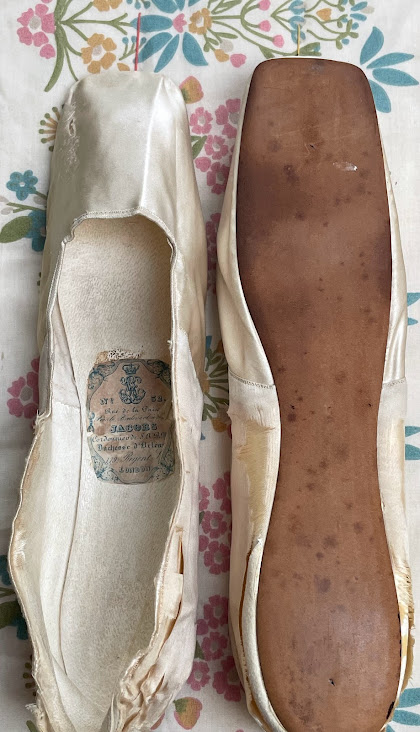
A Pair of Silk Satin Shoes by Francis Jacobs, c. 1840s

According to a paper label adhered to one of his shoes, Francis Jacobs was a mid-19th century ladies shoemaker, with shops at 32 Rue de la Paix, Paris, and 179 Regent Street, London. He counted members of royalty among his clients.


Selected as participant in several European expositions, Jacobs was known for the grace and comfort of his Ladies boots. In 1842, worked with noted physicians inventing a system to help strengthen and straighten the ankles of children. Called the "Contreforte." the boots were made to secure the child's foot without causing discomfort or restricting their movements. 

The silk satin shoes shown here are no doubt examples of Jacobs more common production. They have thin narrow leather soles, and one shoe features a paper label. The shoes were purchased from Finn Wicks Costume, and, in the sale lot, there were two dresses which indicated that the owner/wearer of the shoes was Hanah Elizabeth [Holmes] Woodward (born 1813-died 1849). 


Wednesday, August 17, 2022

Olivia Emeline Lane Dresses, c.1827-1835: Hand Sewn in Stratham, NH

 Olivia Emeline Lane Dresses, c.1827-1835, Stratham, NH 

I recently spent time trying to untangle some of the storyline and chronology for a box of Lane family textiles housed at the Stratham Historical Society, Stratham, NH.[i] The memories and names mentioned in aging handwritten labels seemed in need of clarification. After pondering the various and somewhat cryptic notes and using a variety of online and published sources, I am fairly comfortable with the identity of the wearer of these two charming child’s dresses and their maker: the dresses were worn by Olivia Emeline Lane (14 November 1825- 4 September 1905) and made by her mother, Hannah French Lane (1802-1841).

The two dresses exhibit design details found in dresses c.1825-1830s throughout New England and would be perfect for a child of three to seven or eight years of age, depending on size. Both dresses are entirely hand sewn, with high waists and bodice and sleeve flourishes. Simple drawstrings and buttons serve as back closures. 


One features diminutive Van Dyck trim and a very skillful mending on the sleeve. 


According to the family notes that accompany the garments, the textiles for the dresses were spun and woven by Olivia’s mother, Hannah. Close inspection of the fabric reveals slight imperfections and slubs indicative of home weaving. The likelihood that the material was homespun is furthered by the fact that Hannah was married to Charles Lane (1796-1884). Charles was a son of Jabez Lane and the couple likely lived in his father’s house. Jabez’s father was none other than the renowned New Hampshire shoemaker, Deacon Samuel Lane. Thanks to the work of scholar Jerald Brown and the efforts of the Lane family to preserve their family papers (housed at the New Hampshire Historical Society), we know that female members of Samuel Lane’s household produced flax and wove high quality linen.
[ii] Their work was in demand at various market days. It is not unlikely that later generations retained the tradition, and perhaps the workspace.


After Hannah's death in 1841, Charles remarried. His second wife was Elizabeth Berry Lane, and it appears that her descendants preserved these very special items, as well as a ‘best bonnet’.  


[i] The Lane dresses are housed at the Stratham Historical Society, in Stratham, NH. For information, see Stratham Historical Society at http://www.strathamnh.gov/historical-society

The author thanks Andra Copeland, Skip Stearns, Bruce Kerr and Teddie Smith of the Stratham Historical Society for their assistance throughout the summer of 2022.

[ii] For a guide to the Lane Family Papers at the New Hampshire Historical Society, see: https://www.nhhistory.org/object/272904/lane-family-papers-1727-1924.

For a comprehensive account of Samuel Lane, see Brown, J. E., & Garvin, D.-B.. The Years of the Life of Samuel Lane, 1718-1806: A New Hampshire Man and His World. (Univ. Press of New England, 2000).  For an account of Lane and additional 18th century New England shoemakers and their business, see Alexander, K., Treasures Afoot: Shoe Stories from the Georgian Era (Johns Hopkins University Press, 2018)


Tuesday, August 2, 2022

Found in Collections-Old York Historical Society

Found in Collections:

A little fashion myth busting - not all women had small feet. Museum and family collections are skewed toward small sizes for a wide variety of reasons but careful research and observation tells a more balanced story. For example, here, a woman’s roughly size 10 to 10.5 (by current American sizing) dancing slipper in the classical ‘sandal’ style, was worn c1820s in Maine. Green kid leather and silk, with silk ribbon ties from the collection of Old York Historical Society. 


Thank you to Peggy Wishart, Collections Manager, Old York. 


Sunday, July 31, 2022

“I have labored very hard to keep up courage....": Logbook Entries From An Unidentified Female Hand


This summer, I have been researching account books, day books, ledgers and logbooks at the Phillips Library and found the following of interest. The first part of the log is from a logbook kept from Boston to Havana on the Bark Altorf with Captain Snelling, 1845-46.


Then, at the back of the logbook is an earlier journey from Boston to New Orleans on the Ship Victoria. This voyage begins in 1839 on Sunday 20 January and the log entries are written by an as yet unidentified female hand, possibly the ship captain's wife or the first mate's wife. [Ship Captain’s Wife’s Logbook/Journal 1839, Log 1145, Phillips Library, Peabody Essex Museum] Typically throughout the day or watch, she records the weather, the wind, the sea swells and any unusual occurrences as one would find in comparable logs. There are many unanswered questions about the author of this portion of the logbook but what caught my interest was the uncommon role an unnamed female played in the trip. Three days into the voyage, on Wednesday 23 January, she expresses her fears as she confides:


“I have labored very hard to keep up courage so that I may not be laughed at. We have had very bad weather.[sic] Since I left my dear sweet home.” 


It has been fascinating to follow her through terrible seasickness [“I cared not if I lived or died”] to feeling hale and hearty [“everything tastes good even the salted beef” she reported on Sunday 10th of February]. In addition to gaining her sea legs, she eventually feels comfortable above deck knitting, mending, drinking tea or reading her Bible.


I’m not sure what I will be doing with entries such as this, but it does help me with understanding a wider range of female authorship and voice, which is the current focus of my next two book projects, one set in the late 18th century and the other, in the early 19th.


Monday, December 27, 2021

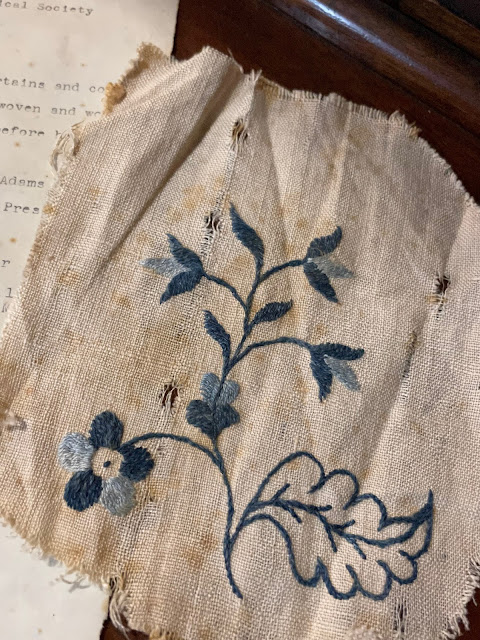
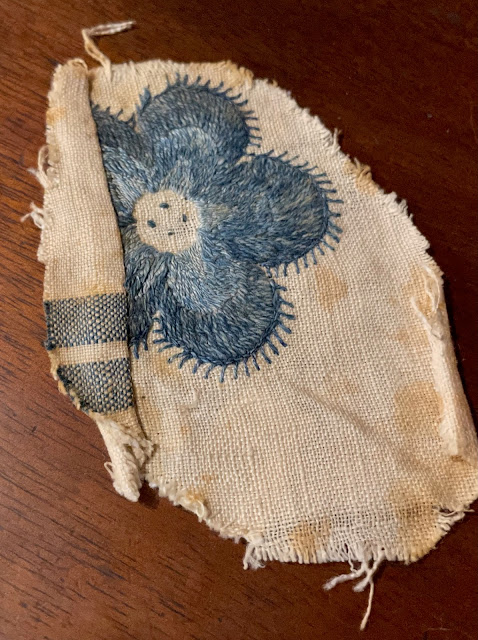
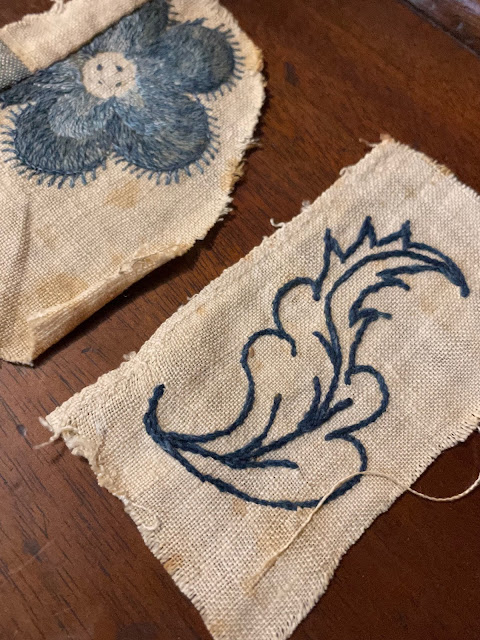
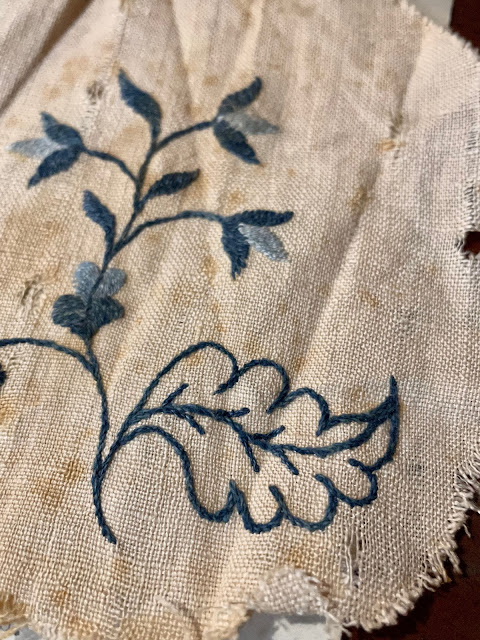
Rachel Adams and Fragments of Her Embroidery, c. 1789

Tucked away safely in a dresser drawer in the Stone School Museum of the Newmarket Historical Society (New Hampshire) are several fragments of what were most likely bed hangings (the donor notes for a canopy bed), made of homespun, hand-woven linen and embroidered with delicate floral motifs, predominately in shades of blue.

The four small pieces of well-worn textiles were donated to the Historical Society on February 14th, 1968 by a descendant of the maker who “vouched for” its authenticity. The label which accompanied the gift notes that the textile was “spun, woven and worked by Rachel Adams of West Medway before her marriage. About 1789.” Her father was Revolutionary War officer, Captain Moses Adams.


Although there remain genealogical issues to work out, the details regarding the actual textile align – the use of small scale motifs and limited palette certainly reflect the visual aesthetics of the last quarter of the 18th century. Further, the tradition of ‘going to housekeeping’ meant that many females of the time created useful household items related to bedding to take into their new home after marriage.

All photos by the author; courtesy, Newmarket Historical Society


Sunday, April 18, 2021

Jacques Henri Lartigue & French Fashion, 1910s

Photographer Jacques Henri Lartigue captured the French elite at play - whether at motorcar racing or at fashionable promenades. 

His work capturing fashion may be seen in numerous examples, such as "Carriage Race Day, Auteuil, Paris, 1911"


Hats, gloves and beautifully designed silk dresses were on display. For a comparison, see a striped silk afternoon dress, c. 1912 by Jeanne Hallee - it is a perfect complement to Lartigue's photo from Race Day.


And more stripes – Paris street style in 1912, photo by Lartigue


Lartigue's images here capture a pre-WWI moment -- a world which will soon experience a crippling war and a devastating pandemic.


Wednesday, August 21, 2019

Fridge List for Fall 2019

Kimberly Alexander 
Upcoming Talks for Fall 2019:

Treasures Afoot: Shoe Stories from the Georgian Era 
and
Fashioning the New England Family

September 9, 7:00pm
Wiggin Memorial Library and Stratham Historical Society, Stratham, NH
Fashioning the 18th Century New England Family


September 28, 2:00pm
Massachusetts Historical Society 
Workshop/Free but registration required
Primary Sources for Fashion & Costume History Research
With Kimberly Alexander, University of New Hampshire and Sara Georgini, MHS
Antique textiles, images of historical figures, and material culture hold a wealth of information that can enrich personal stories, explain relationships, and contextualize the world that people occupied. However, these sources can seem daunting to explore. Two experts on fashion and material culture will guide you through unraveling the stories woven into history’s fabric. This workshop is part of MHS Remember Abigail programming, and Boston Fashion Week


October 1, 6:30pm
Malden Historical Society, Malden, MA
Shoes and Their Stories[part of the Elisha Converse  2020 Exploring the Industrial History of Malden series]

October 16, 7:00pm
Pilgrim Hall Museum, Plymouth, MA
“1 gowne 6 petticoats 1 pair body’s’: Dressing in Early New England


October 25-27
The Honourable Cordwainers' Company35th Annual General Meeting with The Colonial Williamsburg Foundation, Williamsburg, VA
‘Shoes for the Southern Trade’: Northern Complicity & the Shoe Trade in the Early Republic


November 3, 1:00pm
Durham Historic Association
Buying Shoes and Purchasing Patriotism: The Politicization of Footwear, 1760s-1770s


Monday, August 12, 2019

A Child’s 18th Century Lace Stomacher


Carefully preserved in the collections of the Pilgrim Hall Museum in Plymouth, MA. is a diminutive stomacher (Accession #PHM111A). Made for a member of the Standish family, it is 8 inches long and 6 inches wide at the widest point. Triangular in shape, it is made of needle lace insets with a bobbin lace edge. Similar triangular shaped stomachers were an essential component of 18th century women’s dress, serving both to cover stays, and to embellish open robes or gowns. They were easily removable via quick stitching or straight pins.

This charming piece may have been owned by Hannah Standish between 1703-1774, although the maker and wearer are not known.

Many thanks to PHM Director, Donna Curtin, for her assistance.

For additional information, contact https://pilgrimhall.org/ce_library_archives.htm

Wednesday, July 24, 2019

A Textile Portrait in Purple and White, c. 1830


I am so taken with this elegant portrait of a fashionable sitter, c. 1830. I have a fragment only-- one section of the repeat. The original textile from the Cooper Hewitt (collection.cooperhewitt.org), shows two women set within decorative medallions. 
Seen from waist up, these portrait busts are carried out in purple and white cotton, with the engraving done on a plain weave. There is an emphasis on their delicate features, and the latest on-trend dresses, with their voluminous sleeves, and hairstyles for 1830. It would not be surprising if they were based on actual portraits or taken from contemporary fashion plates. I am hopeful a reader may be able to identify the source.
What is especially interesting about the fragment in my study collection, is that, unlike the extant example at the Cooper Hewitt, its was repurposed for a light weight quilt or coverlet as some slightly later time. Although somewhat faded likely due to exposure to light, the piece provides an opportunity to see the hand- quilting up close, and to peek at the cotton batting which is falling away. Underneath is left a ghost of the original portrait, gazing out from her cotton enclosure.


 For an example of the original textile, see: https://collection.cooperhewitt.org/objects/18668091/

Friday, June 21, 2019

Brocaded Silk Shoes: James Adams, London Shoemaker, 1770s


I viewed these elegant court pumps from the collection of the Pilgrim Hall Museum, in Plymouth, MA. (www.pilgrimhall.org) on my summer research road trip in 2018. They are stunners. 
Vibrant, with high quality finish work, these c.1770s brocaded silk buckle shoes exhibit a high Italian heel, oval toe and pattern matched heels & toes. There is evidence of multiple buckle piercings on straps/lachets; they may have been wedding shoes. Note the snippet of the brocade placed on the underside of the upper portion of the tongue - a special visual 'pop' for the wearer.


One shoe features a paper label, identifying the shoemaker as James Adams at the ‘shoe warehouse,’ 224 High Street, Borough, London. Adams is mentioned in Wakefield’s Merchant and Tradesman’s General Directory for London from 1793. 
The accession number is 1373.3a,b

Thank you to curator Rebecca Griffin, and the staff of the Pilgrim Hall Museum for their kindly assistance.

Sunday, May 26, 2019

Leverett Family Petticoat Returns to Colonial Williamsburg

The Leverett family quilted petticoat, reproduced from a pattern created by pricking the design onto muslin, has been returned to the makers at the Margaret Hunter Shop, Milliners and Mantuamakers at Colonial Williamsburg. 
The pricking was in the collection of Massachusetts Historical Society, along with a written description (left by a family member) which noted it was a pale blue silk with silk thread used for the quilting, which gave it the impression of light ‘tissue.’ The recreation of the petticoat was a collaborative project between the Massachusetts Historical Society and Colonial Williamsburg, and was created for display in the exhibit entitled Fashioning the New England Family, on view from October 2018-April 2019. 
Fashioning the New England Family, www.masshist.org
Mannequins by Astrida Schaeffer
It is now safely in the hands of Mistress Whitacre, where it will be used for educational and interpretive purposes. It was entirely hand sewn by the milliners and mantua-makers.
For information on the project, see: 

For information on the exhibition, see:

For an interview with Jared Bowen of Open Studio on WGBH:

Wednesday, May 8, 2019

The Latest in Mourning Wear: Advice from Harper’s Bazar, 1901


“Crepe is more fashionable than ever” notes the November 1901 edition of Harper’s Bazar. “House gowns and dinner gowns made entirely of crepe and in the princesse style are exceedingly becoming, while there is permitted on crepe dinner gowns a trimming of the dull jet passementerie.”

Making reference to the fact that “all of England is in mourning” –Queen Victoria died on the 22ndof January, 1901 -- the author observed that it is no wonder that there was a plethora of choices of style and textiles available on the market. The writer also notes that after the first expenditure of the dress and appropriate accessories, it is possible to get along with “fewer gowns than when wearing colors.”

I recently found this volume of Harper's
in fine condition at the Avenue Victor Hugo Books in Lee, NH (May 2019).

Sunday, April 7, 2019

Mrs. Catherine Donovan, Dressmaker to the NYC Elite

Irish–born dressmaker to New York’s elite, Mrs. Catherine Donovan (1826?-1906), studied fashion in Paris. Donovan created her gowns in her fashionable shop and showroom in New York. By 1900, she was located on Madison Avenue. In addition to her designs, which were heavily influenced by French couturiers, she also sold gowns by Worth and Pingat. In her use of materials and her design idioms, she favored the historical references employed by her French contemporaries.


Numerous evening, and afternoon dresses, and ball gowns survive in North American museum collections, and they frequently come up in auctions as well. It is clear that Donovan was able to provide a wide variety of styles for her discriminating and affluent customers.

As noted by the Philadelphia Museum of Art
“After her death in 1906, Irish-born Catherine Donovan was described by the New York Times as "the pioneer dressmaker of the 400," for dressing New York's social elite known as the "400." She owned a building on Madison Avenue at 40th Street, where she sold imported gowns from leading Paris couturiers such as Charles Frederick Worth and Emile Pingat. At least once, her employees' baggage was seized at U.S. customs on suspicion of smuggling. It was common practice for seized goods to be auctioned publicly, and in 1893 over five hundred people attended an auction of Worth, Pingat, and other gowns seized from Donovan.”
This evening ensemble (bodice and skirt), c. 1885, looks to France for inspiration, as well as historical references from the 17thand 18thcentury. The ensemble features a flowered, striped pale blue silk moiré, pale blue silk satin, and ecru lace at the Philadelphia Museum of Art (http://www.philamuseum.org/collections/permanent/176664.html)

Here, a red and ivory checked cotton dress, complete with ivory cotton dickie, c. 1885 from the Metropolitan Museum of Art.

A two-piece ball gown, c1890s, metallic silk brocade trimmed in cutwork velvet and cord, skirt pleated at center back, hem lined in lace. Courtesy, Whitaker Auctions (https://whitakerauction.smugmug.com/Spring2012-2/Clothing/ID-247/i-7BhBgWq/O)

Fortunately, her name and address is stamped on her petershams, providing an opportunity to trace her various locations from the 1880s through the early 1900s-- "Mrs. C. Donovan/315.5th Ave./N.Y.," "Mrs. C. Donovan/245 5th Ave./New York," or "Mrs. C Donovan & Co/280 Madison Ave./ New York."