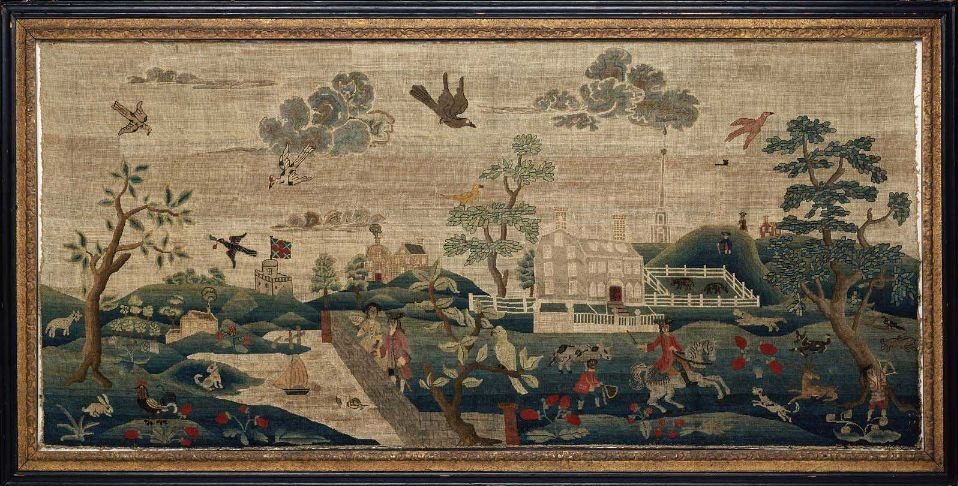
Hannah Otis’s (1732-1801) sampler “View
of Boston Common” (c. 1750, Museum of Fine Arts, Boston) is a charming and
significant pictorial narrative, capturing life in Boston prior to the
Revolution. The connection of the
sampler to a significant New England family, the documentary nature and large
over-mantel size all serve to distinguish it as a preeminent example of school
girl skill and, in this case, creativity. It is embroidered in wool and silk on
a linen canvas.
This sampler is a delight, and the
more time one takes to examine it, the more one sees. Note the British flag
waving energetically above the pre-Revolutionary blockhouse, for example. Of
particular interest is the representation of the impressive Georgian style Hancock
Mansion (demolished in 1863) with its fences, orchards and parterres. The
elegant occupants are enjoying the bountiful and exuberant landscape, peppered with unusual birds, animals and over scaled plantings, which Hannah
Otis has created for them. The
couple standing near the wall (just to the left of center) were most likely Thomas Hancock (1703-1764) and his wife, Lydia
Henchman Hancock (1714-1776), with their stately home and grounds as a backdrop. Thomas
Hancock wears a long red (?) coat with substantial cuffs, a waistcoat, breeches
with white hose, and what appears to be a tricorn hat. Lydia Hancock is dressed
in the elite fashion of the time, sporting a light colored dress (probably
silk) and stomacher.
Thomas
Hancock was John Hancock’s uncle. Known as a very wealthy merchant (as well as
a probable smuggler) and head of the “House of Hancock,” he opened his home and
business to his orphaned nephew, John. Indeed, it would not be surprising if
the lad on horseback, with a black liveried groom, depicted in Otis’s sampler
was in fact the adolescent John. Born in 1737, he would have been around
thirteen years of age. Like his aunt and uncle, young John
wears appropriate, fashionable clothing. He is clad in riding gear, including
high leather boots.
 |
Detail, Thomas Hancock, 1730, by John Smibert
Museum of Fine Arts, Boston |
 |
Lydia Henchman Hancock, by John Singleton Copley
National Portrait Gallery |
For more, see The History Blog http://www.thehistoryblog.com/wp-content/uploads/2012/01/View-of-Boston-Common-Hannah-Otis.png
“The most expensive sampler ever sold is View of Boston
Common by Hannah Otis (1732-1801), stitched around 1750. It’s a huge piece,
meant for display over a chimney mantelpiece, embroidered in wool and silk on
linen canvas. It was purchased by the Museum
of Fine Arts, Boston at Sotheby’s in 1996 for a record $1,157,500.
Hannah Otis is closely linked to the American Revolution and
American history in general. She was born in 1732, the daughter of Colonel
James Otis and Mary Allyne Otis. Her mother was a descendant of Mayflower
passenger Edward Doty. Her father was a judge and representative to the Massachusetts
legislature. He was a fervent anti-royalist as was his son, James Otis, Jr.,
who introduced the phrase “Taxation without representation is tyranny” during
the Stamp Act debates. Hannah’s older sister Mercy Otis Warren was a poet,
playwright and historian who published numerous pro-Revolution writings and
corresponded with the luminaries of the American Revolution like John Hancock,
Thomas Jefferson, George Washington and John Adams.
The sampler remained in the Otis family until the 1996 sale.
It had been on loan at the Boston Museum of Fine Arts for over 40 years when
the family decided reluctantly that they had to sell it.”