Showing posts with label 19th century fashion. Show all posts

Thursday, December 28, 2017

Two Refashioned Silk Dresses

Photograph by Laura Wulf @Massachusetts Historical Society
Exhibit Teaser: Two refashioned silk dresses will be featured in the forthcoming exhibition at the Massachusetts Historical Society (https://www.masshist.org) ‘Fashioning the New England Family’ which opens October 2018. The lush, emerald green dress on the left began as Spitalfields silk damask wedding dress, worn by Rebecca Tailer [Byles] for her Boston wedding to Reverend Mather Byles, in 1747. It was altered, clumsily, c.1830s-40s, most likely for a costume or fancy dress event. Her matching shoes are extant and will also be on view.

Photograph by Laura Wulf @Massachusetts Historical Society
Unfortunately, we do not know who made or wore the well-constructed pale green silk dress on the right. It shows the hand of a skilled dressmaker and most likely has a New England connection. Examination by costume historian and mannequin maker, Astrida Schaeffer, revealed the possibility that the original c1830s dress was replete with popular pouf sleeves, which were painstakingly remade for the 1840s.

Photograph by Laura Wulf @Massachusetts Historical Society
Guest Curator, Kimberly Alexander, Ph.D.
MHS Curator, Anne Bentley
Photographer, Laura Wulf


Both dresses are shown on custom mannequins made by Astrida Schaeffer of Schaeffer Arts. (http://www.schaefferarts.com/)

Thursday, July 6, 2017

Versatility of a Victorian Farm Wife’s Wedding or Best Dress


 The Newmarket Historical Society, Newmarket, NH held an exhibition of wedding dresses from New England, housed in the collection of the Society. The exhibition was on view from June-August 2016. Most of the wedding dresses were modest, and many were sewn by family members (well into the 1970s)—mothers, sisters, aunts.


Among what we consider the traditional wedding finery, were two “best” dresses –most likely worn for the respective bride’s weddings—one by the mother and the other by her daughter.  Both married farmers. [[1]]

The mother was Phoebe Marie Prime, who married Benjamin Philo Downs, January 25th 1843 in South Britain, CT.  She died at an early age, probably of consumption. Her daughter, Emma Marie Downs, was raised by her aunt and guardian. Anticipating disapproval from her aunt, Emma and her husband to be, David Chester Platt, ran away to get married. They married on December 28th, 1874 in New York, and ultimately resided in her hometown, South Britain, CT. The ending, however, is a happy one. At a later point, her guardian felt it was prudent to save face in the town and gave the newlyweds a very large reception.


Emma’s “best” dress is extant. Clearly well-worn, her cotton print dress dates from the last quarter 19th century.  The dress features a fitted, integral bodice. Adjustable interior ties at the waist may indicate that the dress was also designed to serve as maternity wear.


In addition to her ‘best’ dress, a simple blue and white checked cotton gown survives from the late 19th century, and so does one of her husband’s waistcoats. Both garments exhibit straight forward practicality, and modest materials, with little if any additional embellishments. They are clearly well 
worn and functional.


[1] The dresses are in the collection of the Tarbox family, on loan to the Newmarket Historical Society

Wednesday, July 5, 2017

Fashionable Folks: What New Englanders Wore, 1830s-1920s

Recently, I had the opportunity to visit 'What New Englanders Wore, 1830s-1920s'  on view at The Colonel Paul Wentworth House Rollinsford, New Hampshire Curated by Julia Roberts.


The Col. Paul House is a great destination spot for a Sunday ramble around New Hampshire. The house and the exhibit are open Sundays 1-4 through October 8th 2017.  For details, see http://www.paulwentworthhouse.org.


Tuesday, May 23, 2017

Early 19th Century Fashions from the Corriere delle dame, Milan

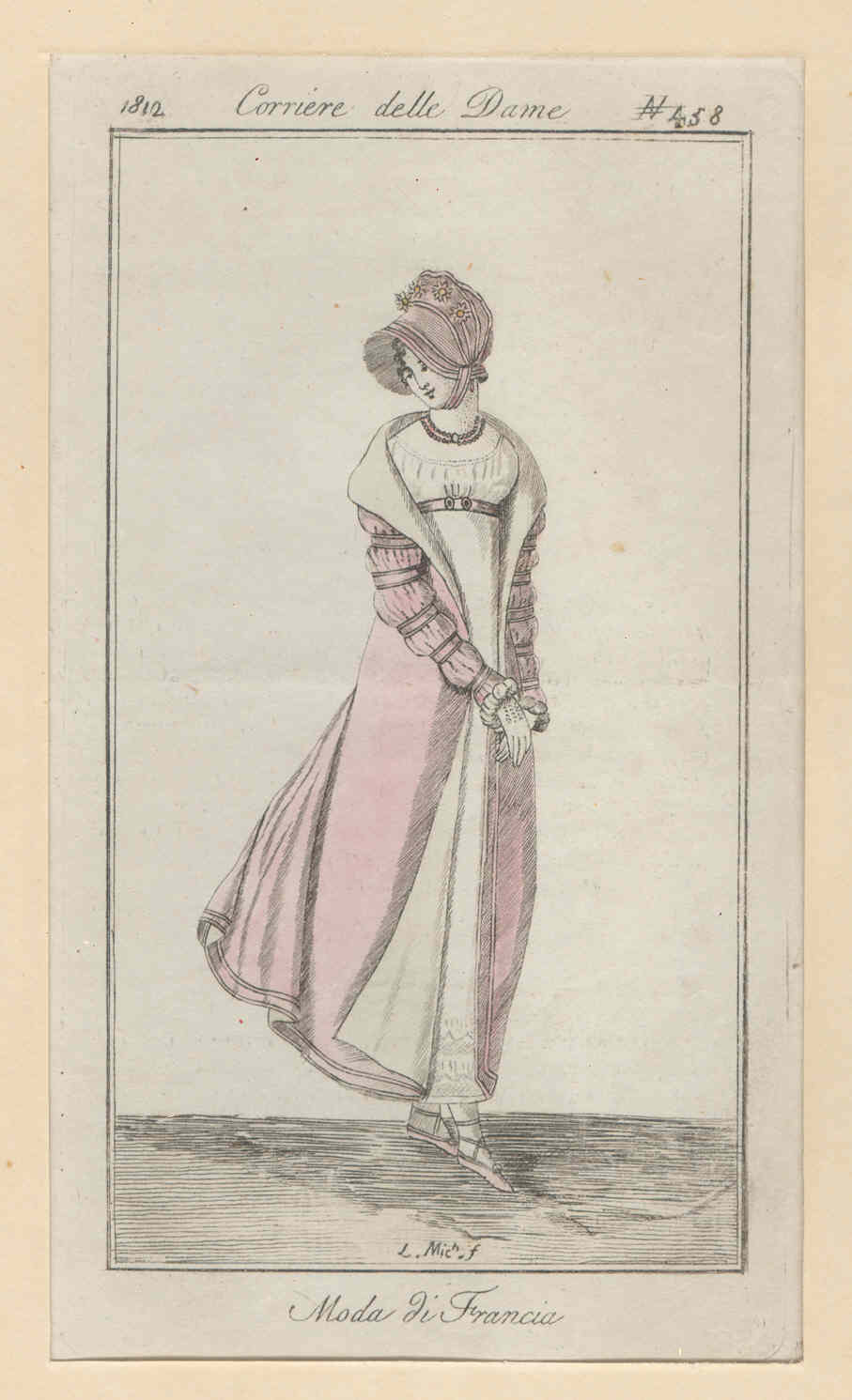
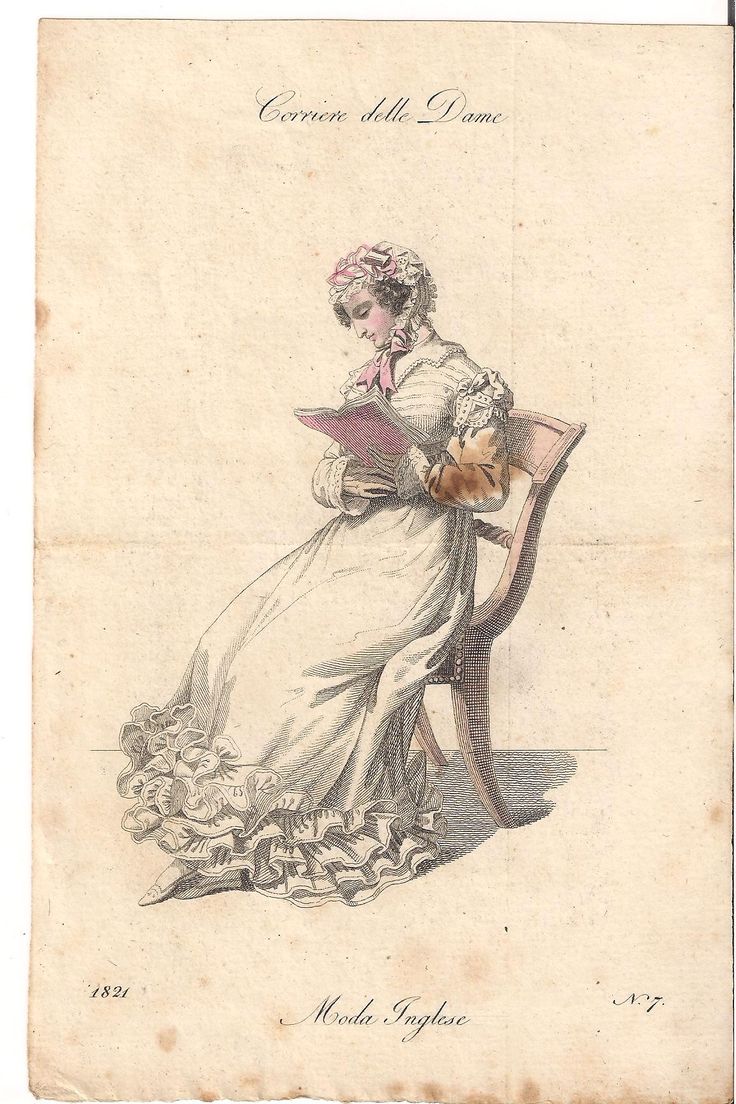
I recently came across several pages from Italian magazine entitled the Corriere delle dame. Established in1804, the weekly magazine was published out of Milan. The founder and editor was Carolina Arienti Lattanzi, and included articles on literature, theatre and fashion throughout Europe, particularly France, Italy, and less frequently, England. What caught my eye was the charming fashion plate from 1812 illustrating the French Empire style – ‘Moda di Franci’. [1]

Note the simplicity of the white dress, with extensive self-fabric detail in the form of pleating and various gathers at the bodice back, which is trimmed in red. Note the just above the elbow off white gloves. A frilly lace bonnet, standing lace collar, small red dots along the hem, and red and white stripped slippers complete the look.
The year before this ensemble was published, readership was 700; by 1875, it had ceased publication. Historians have noted that this pioneering publication played a role in increased female voice and emancipation for elite Italian women in the 19th century.[2]


1.      A number of images are available through the digital collections of the New York Public Library:

2.         For additional information, see Il Corriere delle Dame, tra moda, politica e femminismo http://www.luukmagazine.com/il-corriere-delle-dame-tra-moda-politica-e-femminismo/