Showing posts with label 18th century textiles. Show all posts

Monday, December 27, 2021

Rachel Adams and Fragments of Her Embroidery, c. 1789

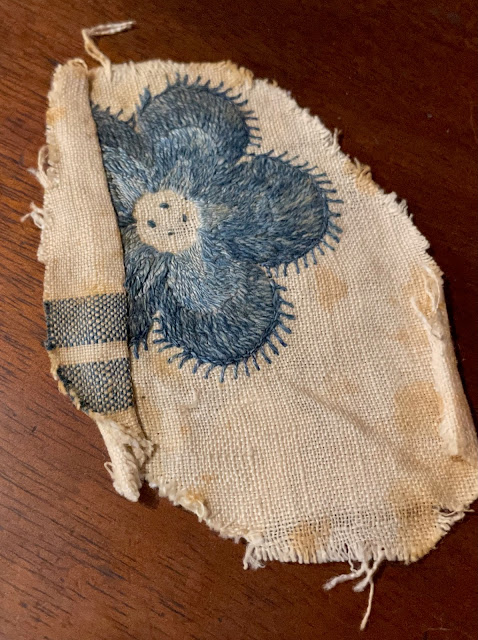
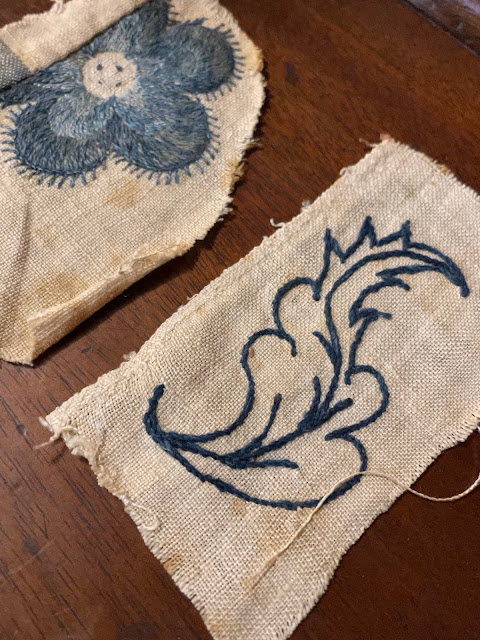
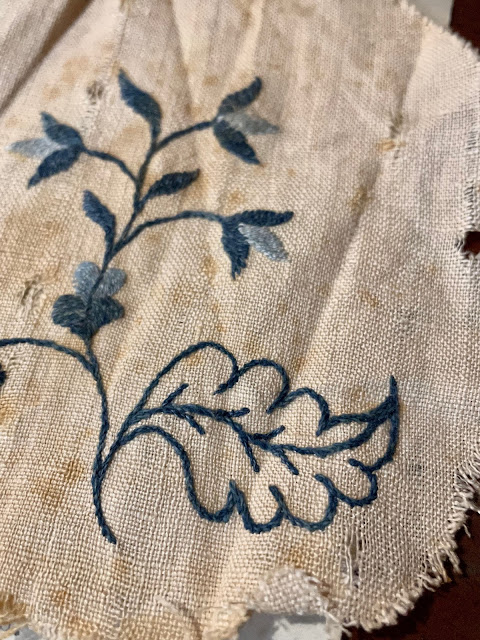
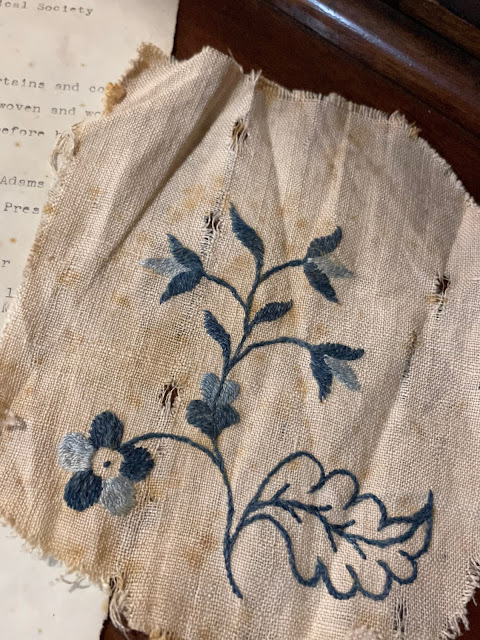
Tucked away safely in a dresser drawer in the Stone School Museum of the Newmarket Historical Society (New Hampshire) are several fragments of what were most likely bed hangings (the donor notes for a canopy bed), made of homespun, hand-woven linen and embroidered with delicate floral motifs, predominately in shades of blue.

The four small pieces of well-worn textiles were donated to the Historical Society on February 14th, 1968 by a descendant of the maker who “vouched for” its authenticity. The label which accompanied the gift notes that the textile was “spun, woven and worked by Rachel Adams of West Medway before her marriage. About 1789.” Her father was Revolutionary War officer, Captain Moses Adams.


Although there remain genealogical issues to work out, the details regarding the actual textile align – the use of small scale motifs and limited palette certainly reflect the visual aesthetics of the last quarter of the 18th century. Further, the tradition of ‘going to housekeeping’ meant that many females of the time created useful household items related to bedding to take into their new home after marriage.

All photos by the author; courtesy, Newmarket Historical Society


Sunday, November 18, 2018

A Baptismal Apron Embroidered by Mary Woodbury, c. 1735

I thought you might enjoy the story connected with this baptismal apron, c. 1735. Currently on view in Fashioning the New England Family at the Massachusetts Historical Society (10/2018-4/2019; www.masshist.org), it was embroidered by Mary Woodbury (1717-1748) of Beverly, Massachusetts.[1] 
All images are courtesy of the Massachusetts Historical Society; photographer, Laura Wulf.
Using familiar 18thcentury iconography inspired by Asian motifs -- vases/urns of exotic flowers, flying phoenix/hoho birds--it is replete with silk and metallic threads, as well as small spangles. The primary stitches are flat and satin stitches. The colors are still bright against an extremely fragile silk ground. Born on March 3, 1717, the maker may have attended a female academy in Boston. 


She married Dr. Benjamin Jones on March 3, 1736/7.  She died the day before her 31stor 32nd  birthday. The baptismal apron was most likely made for her own child, embroidered when Mary was around age 18-19. After her death on March 2, 1748, her belongings were carefully saved for her daughter, Lydia, by Dr. Jones' second and third wives.  Lydia later married the Rev. Thomas Lancaster, who was minister of Scarborough, ME. from 1775 to 1831.

A baptismal apron such as this one, was worn by the infant. The term "apron" appears to be used in the 17th century and into the early 18th. Changes in baptismal practices - the move away from full immersion -- allowed for the better known Christening dress or gown to supplant the earlier ensemble, which often included the apron, a bib, mitts, and cap. The use of bearing cloths in the 17th and 18th century was also common. The example embroidered by Mary Woodbury has proportions closer to the apron than the square bearing cloth. Further, her family had settled in Massachusetts in the 17th century, likely continuing the practices from home. A full ensemble from the Victoria & Albert Museum may be seen here: ‪react-text: 204 Victoria and Albert Museum /react-text :‪react-text: 207 http://collections.vam.ac.uk/.../baby-clothes-unknown/


1. Accession # 0168
Given by the grandchildren of Dorothy Lancaster Libby, through Charles Thornton Libby of Portland, ME, on August 5, 1931.
References   MHS Proceedings64; 346

2. A second, and very unusual, example of her work, also survives at the Massachusetts Historical Society – a painting of Pocahontas. This may well be the first representation of Pocahontas by a woman. For more, see https://www.masshist.org/database/1747


Monday, May 8, 2017

Fashioning the New England Family, Massachusetts Historical Society

MassFashion: Fashioning the New England Family
Massachusetts Historical Society
October 2018 – March 2019
I am delighted to announce that I am serving as the Guest Curator for ‘Fashioning the New England Family’ which will be on view at the Massachusetts Historical Society, Boston, MA. from October 2018-March 2019. (https://www.masshist.org) Working with the MHS Curator, Anne Bentley, we are planning a exhibition which will place numerous garments and accessories on public view for the first time in MHS history. In addition to the exhibition there will be an accompanying catalog.

As America’s first historical society, the Massachusetts Historical Society has collected family archives since 1791. Textiles form an important part of these family stories but, due to their different storage requirements, have largely been divorced from their familial ties. Fashioning the New England Family will reknit the family stories with their textiles.  Exploring textiles and clothing, we read them as primary source material enabling us to trace patterns of consumption and trade, examine clothing as political and social statement, and to compare and contrast men’s political-economic sphere to women’s. A particular collecting strength is found in the items preserved from the 17th and 18th centuries, largely represented in the MHS collection by Boston’s elite families. Very few of these items have been publicly exhibited. While the importance of luxury goods continues in the 19th century, we see an increase in the availability of specialized garments and accessories through all strata of society and from a wider range of sources. During this period (and continuing beyond the Colonial Revival) the importance of “ancient” textiles frequently acquire icon status and serves to connect the next generation about the importance of family history. 
Four primary themes comprise Fashioning the New England Family:

I.               Petticoats and Politics  (Presidents Gallery)
II.             The Embellished Gentleman (Hamilton Room)
III.           Clothing “The Quality” 18th c. and 19th c. (Oliver Room)
IV.           Homespun & Handsewn (Alcove off of Oliver Room)
I am also pleased to author the catalog which will accompany the exhibition.

Stay tuned for more details and exhibition teasers.
Tuesday, September 20, 2016

A Pocketbook For Benjamin Stuart, 1753

This vibrant crewel pocketbook was made for Benjamin Stuart of Boston and is dated 1753. It is held in the collections of the Massachusetts Historical Society (http://www.masshist.org). The pocketbook features a brightly hued pastoral view with vining flowers, bird, and goats. Several large blossoms catch the eye. The wool thread is worked on linen, and features a dazzling interior, lined with silk. The wool threads have remained vivid, as has the yellow-gold silk lining (the silk is possibly from China.)


While the owner is known, the maker is anonymous. Items such as this were often made by young women for their fathers, beloveds, or for themselves. As noted by MHS Curator, Anne Bentley, the large size of the pocketbook was fashioned to accommodate old tenor currency.


Monday, March 21, 2016

The Reproduction of Garments from Sarah Williams 1738 Probate Inventory


Reproduction swatches flank the display and invite visitors to touch the textiles
One of the many engaging aspects of the The Helen Geier Flynt Textile Gallery (a permanent exhibition area in the Flynt Center of Early New England Life) at Historic Deerfield, are four half-scale fashion or dress 'mannequins.' They are clothed in reproductions based on items found in the probate inventory of a young Deerfield woman, Sarah Williams (1716-1738), who died in 1738 at age 21. She was unmarried. Her headstone survives at the Old Deerfield Burying Ground. [1]

The  model displaying "silk" (petticoat, open robe, stomacher) as they might have appeared from Sarah's garments.

Miss Williams came from a very wealthy family as may be seen by the number and type of garments listed in her probate inventory. Among the extensive list: one taffeta robe at 6 pounds; one damask robe at 3 pounds 15 shillings; one chintz robe; one calico robe; one silk quilt; one shalloon quilt and cloth cut for a riding habit and trimming. The reference to one riding hood indicated it was quite costly at 4 pounds 5 shillings. Her inventory also listed three pairs of stays: black, yellow and red. There are several references to unfinished garments or accessories perhaps indicating, in the case of  “cloth for a pocket” that Sarah was sewing the item just prior to her death. The range of items available to Miss Williams in the 1730s certainly calls into question long held mythologies regarding colonial dress.


The Gallery is comprised of four sections representing silk, wool, cotton and linen and the theme is carried through with the half scale mannequins.

1. Additional information provided by Edward Maeder, Curator of Textiles from 2000 to 2008, regarding the four figures wearing clothes inspired by the Sarah Williams probate inventory.  Mr. Maeder spent many months working on this inventory and tying it to the customs records of the period.  He was able to photocopy the London-New England customs records from 1697 (the 1696 ones were lost in a fire) to 1780 from the Public Records Office in Kew.  

The idea to use this information, along with the probate inventory, and to create these figures came out of a 2007 discussion with Kiki Smith of Smith College. She suggested a colleague of hers, Henry Johnson, a talented costume designer at Shakespeare and Company in the Berkshires, would be a perfect person to do the fabrication. They held several meetings, and combining resources, decided on patterns for each of the garments worn by the individual figures.  It may be of interest to readers to know that Mr. Maeder himself quilted the yellow silk petticoat worn with the silk mantua.   The wool petticoat, embroidered with the crewel design, was stitched by Kathleen Smith, of Montague, MA, and one of the foremost specialist for the recreation of 18th century embroidery.

For the full inventory, see www.historicdeerfield.org

http://www.historic-deerfield.org/files/4813/7450/7840/WILLIAMS_SARAH_1716-1737.pdf


Thursday, November 19, 2015

A French Plaid Silk Taffeta Boutis Quilt, c. 1760s+


How many more wonderful textile related words can you squeeze into this title? Plaid. Silk. Taffeta. Boutis. Quilt. Each on its own denotes something special, but when taken together? It is beyond the ordinary, everyday.

This cheerful French silk taffeta, most likely intended for a dress, was in circulation by 1764 --it  appears in Selling Silks: A Merchant’s Sample Book by Leslie Ellis Miller. There is at least one extant example of a gown made from the same or very similar plaid, sold at Whitaker Auction.


 However, at some point -- probably a few decades later than the silk production date—it is transformed into a French quilt (c.1800?). The quilting is of a type known as boutis. Boutis work is a Provençal word meaning 'stuffing', describing the manner in which two layers of fabric are quilted together with stuffing sandwiched between sections of the design, creating a raised effect. [1] This example is charming, and includes hearts at the corners. You can see bits of the cotton wadding or batting used to “puff” out the quilt, typical of boutis work.


Taffeta is a very thin silk. The batting used to quilt the boutis has pushed the silk, causing strain and resulting in damage. However, the design of the hand stitching also holds the silk together. Although damaged due to folds and wear, with tears to the boutis and shattered silk, it nonetheless is valuable as a study piece.


Formerly from www.Trouvais.com collection