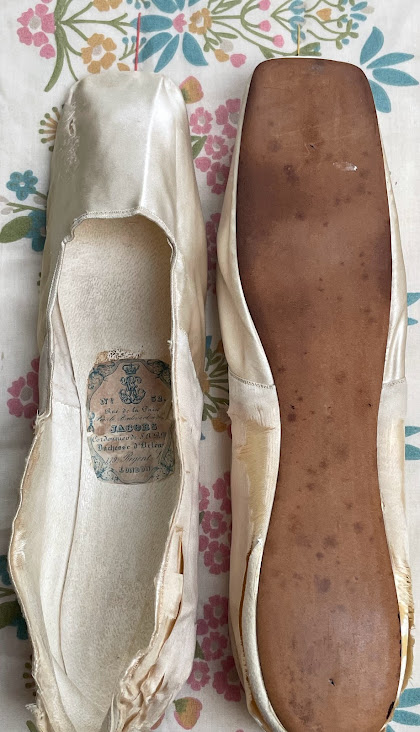
I recently happened across a labeled silk damask shoe in the past offerings of Augusta Auctions. The
shoe & its label piqued my interest. The physical details are
well documented at www.AugustaAuction.com.
1
Intrigued by
the rich mocha hues, I could see past the wear and abraded surfaces to imagine
the shoes with their original silk sheen and a pair of glittery shoes buckles.
But it was a Pre-Revolutionary, Providence, Rhode Island label, identifying the
maker, which truly captured my interest. I have spent considerable time
corralling shoe labels from the UK and the Colonies for current research on
shoes as trade commodities.
Naturally, this
small label served as an advertisement or calling card for “John Gonsolve” and
his business, located near the Mill-Bridge. Gonsolve clearly had success in his
trade as a shoemaker, as one of his advertising notices from 1785 attests: he is seeking “Any Gentlemen of the Craft, duly qualified…and wanting a
Seat in my shop…may have constant Employ, and good Wages.”
Gravitating to the
inked in date of "1767" posed a number of questions: Was it added by
the shoemaker or the wearer of the shoe and her descendants? Were the shoes
preserved by the family because they were a tangible artifact of their
ancestors lives or because they were treasured heirlooms representing stories lost to the historic record? Given the impeccable provenance,
knowing that the original owner of this pair of damask shoes was Phebe Wardell
Smith (1748 – 1840), I dug a bit deeper.
As it turns out, she
was married in December 1767 to James Smith of Bristol, Rhode Island (c.
1745-1826), indicating these were probably her wedding shoes. Details about her
husband's life are hard to come by, with one significant exception: the recent discovery
of his connection to the burning of the British cutter Gaspee in Providence in 1772.
One of Smith’s compatriots, Ezra Ormsbee, notes in his pension application:
"In June 1772
when the English Revenue Cutter Gaspee was burnt in Providence River, I was one
that went from this town and helped do it. Capt John Greenwood, James
Smith, Abner Luther, Abel Easterbrooks, Nathaniel Easterbrooks,
Hezekiah Kinnicut and myself went together in a whale boat and we helped burn
her. I mention this merely as a revolutionary incident and not as connected
with my pension claim. All the above named persons who were with me in burning
the Gaspee have a long time now decd." 2
 |
The Burning of the Gaspee by Charles deWolf Brownell, c1892
Courtesy of RI Historical Society
|
Married for about
five years at the time of the destruction of the Gaspee, one can only speculate about what
Phebe, as the wife of very active participant in the Revolution, experienced.
Certainly, her now well-worn shoes walked many miles, perhaps pacing with
concern for his safety, during those tumultuous times. Indeed, Phebe and her
young children removed to Dighton, Massachusetts for the duration if the
conflict. The couple had six children.
One additional
document provides information about James Smith’s role in the Revolution –
Phebe’s pension request. Interesting reading, it is quoted in full from the
Gaspee Virtual Archives below.3
Phebe died on
September 23, 1840 at 92 years old, handing her shoes down to Fanny Smith.
Notes
1. Listing from
Augusta Auctions:
Sage green &
beige damask, white kid leather Italian style heel & rand, linen lining,
leather sole & insole, square paper label stamped "SHOES, Made and
Sold by JOHN CONSOLVE, In PROVIDENCE" and inked on label "1767",
L 9.25", Wd 3", Heel Ht 1.75", (silk torn around back bottom
edge of each shoe, slight wear at toe point, silk binding tape missing on top
edges & latchets) fair. Provenance Phebe Wardwell Smith, from MA., mother
of Fanny Smith (b. 1789), grandmother of John Jay Jenks (b. 1847).
2. Genealogical
researcher, Pam R. Thompson wrote to the Gaspee Days Committee (www.gaspee.com) in 2005 that she had
discovered a curious entry in the Revolutionary War Pension File, #S21404, for
Ezra Ormsbee, born 30 March 1751 in Warren, RI, son of Ebenezer Ormsbee
(sometimes spelled Ormsby) and Hannah Cole (Benjamin3, Hugh2, James1) Ezra applied for his pension in Warren,
RI, on 24 August 1833. It is here that the role of Smith is recognized.
3. Sections in bold added by author.
The Gaspee Virtual
Archives note that Phebe, as James' widow, applied for pension (W12985) based on
the Act of 1836 for his Revolutionary War service.
“Unfortunately, the
copy available on HeritageQuest through NEGHS is hard to read--much of this is
guesswork. The pension appears to have been applied for on 3Oct1836 from
Bristol, RI, which was granted of $30 per year, and notes he served as a Private in the Captain Jeremiah Ingraham's
Company of Bristol Militia from the commencement of hostilities until January
1776. In January 1776 he enlisted
into Captain Loring Peak's Company, serving three months while the company was
stationed at Bristol. In 1777 her husband enlisted into Captain Caleb Carr's
Company of Colonel Archibald __(?Throop)__'s Regiment one year while in
Bristol, and at which time she and her children were inhabitants of Bristol
during the Alarms, from which she moved to Dighton, MA and remained for the
remainder of the war. She did
recall that her husband served out the war, and that he had been attached to
Colonel Ormsby's Regiment [A connection to the Gaspee ]. She also recalled her
husband was involved with British General Sullivan's capture from Portsmouth,
RI. She stated that she
married James Smith in Bristol in December 1767, and that her husband James
Smith died on 30June1826, and that she had since remained a widow. Documentary
evidence accompanying the application includes a certification of the marriage
between Phebe Wardwell and James Smith, and relates that James was the son of
Samuel Smith of Bristol, and Phebe was the daughter of John Wardwell of
Bristol. There is also a statement
from James Smith, Jr corroborating
the facts as his mother claims. There is no mention made in the pension
paperwork about the Gaspee attack.”
All images of Phebe Wardell Smith's shoes are courtesy of www.augusta-auctions.com. You can find Augusta Auctions on Facebook and Twitter.