Showing posts with label Wedding dresses. Show all posts

Wednesday, August 8, 2018

An 1879 Wedding Dress Designed by Madame Shepherd of Boston

All images are courtesy of the NSCDA-MA
This striking silk satin wedding dress was designed by a Boston dressmaker, Madame Shepherd. Her studio was located in the Hotel Pelham, a fashionable French flat residence.  Madame Shepherd appears in the Boston City Directories over a number of years, listed under “Dressmakers.” 


Although the wedding dress appears as a two piece ensemble of bodice and skirt, it is in fact constructed in one piece. Worn on November 5th, 1879, the balance between pleated upper bodice, the high neck trimmed with lace, and the floral patterned silk skirt, embellished with beads and faux pearls, is dynamic. The silk, the details, and the quality of the dressmaking are excellent. 


The wedding dress and the accessories shown here are from the NSCDA-MA Costume Collection, Accession Number MA-CC-1953-13A. For more, contact https://nscdama.org

The author thanks Rebecca Putnam and the members of the costume committee for their assistance.

Thursday, July 6, 2017

Versatility of a Victorian Farm Wife’s Wedding or Best Dress


 The Newmarket Historical Society, Newmarket, NH held an exhibition of wedding dresses from New England, housed in the collection of the Society. The exhibition was on view from June-August 2016. Most of the wedding dresses were modest, and many were sewn by family members (well into the 1970s)—mothers, sisters, aunts.


Among what we consider the traditional wedding finery, were two “best” dresses –most likely worn for the respective bride’s weddings—one by the mother and the other by her daughter.  Both married farmers. [[1]]

The mother was Phoebe Marie Prime, who married Benjamin Philo Downs, January 25th 1843 in South Britain, CT.  She died at an early age, probably of consumption. Her daughter, Emma Marie Downs, was raised by her aunt and guardian. Anticipating disapproval from her aunt, Emma and her husband to be, David Chester Platt, ran away to get married. They married on December 28th, 1874 in New York, and ultimately resided in her hometown, South Britain, CT. The ending, however, is a happy one. At a later point, her guardian felt it was prudent to save face in the town and gave the newlyweds a very large reception.


Emma’s “best” dress is extant. Clearly well-worn, her cotton print dress dates from the last quarter 19th century.  The dress features a fitted, integral bodice. Adjustable interior ties at the waist may indicate that the dress was also designed to serve as maternity wear.


In addition to her ‘best’ dress, a simple blue and white checked cotton gown survives from the late 19th century, and so does one of her husband’s waistcoats. Both garments exhibit straight forward practicality, and modest materials, with little if any additional embellishments. They are clearly well 
worn and functional.


[1] The dresses are in the collection of the Tarbox family, on loan to the Newmarket Historical Society

Monday, July 4, 2016

The Parachute Wedding Dress and World War II Era Brides

Photo, courtesy, Newmarket Historical Society
Sandra Tarbox (www.ColonialTable.com) and I recently co-curated a local history exhibition “I Do, I Do: Seacoast Brides Say Yes!” in Newmarket, New Hampshire. When we searched our collections and sent out a regional request for 1940s wedding gowns, we were not surprised that we had little response. Many of our parents and grandparents married just as their beloved was sent to the European theatre of war.Weddings were frequently small, hasty gatherings. And many brides shared their wedding garb with other brides, passing skirts, jackets or entire dresses along until little was left.

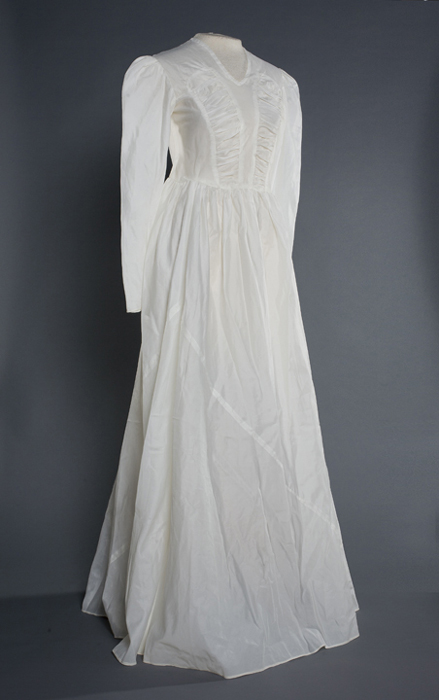
One of the most intriguing examples of surviving World War II wedding dresses are those made from either silk or nylon parachutes. There are surviving examples scattered in museum collections across the country. Locally, the Old Berwick Historical Society (www.OldBerwickHistoricalSociety.org)  has in its collection the wedding dress of Ruby Weston Trafton of South Berwick, which was made by Betty Trafton, the bride’s sister of a silk parachute.

Below are two stories about dresses made from parachutes, which include happily-ever-after endings. The photos and text are courtesy of the National World War II Museum and the Smithsonian Institution.

Wedding of Myrtille Delassus and Berlin, NH. Sgt. Joseph Bilodeau, 1945


Myrtille Delassus was seventeen when the Germans invaded her hometown of Merville, France. She spent four long years waiting in ration lines, cold and perpetually hungry. She could hear the Allied invasion of Normandy and, like many others, welcomed British and American soldiers when they arrived in Merville.

 GIs were generous with their surplus supplies, and one soldier, Sgt. Joseph Bilodeau of Berlin, New Hampshire, often gave items to Madame Cocque, the owner of a dress shop across the street from where he was stationed. One evening, Madame Cocque invited Sgt. Bilodeau to dinner to thank him. Since it would appear inappropriate for her to dine alone with him, she invited Myrtille, who worked in her shop. Myrtille and Joseph enjoyed each other’s company and started dating. They were married six months later on October 15, 1945, at the church in Merville.

Myrtille’s wedding dress was made from a silk parachute by the women in Madame Coque’s dress shop. It features a classic silhouette with a double ruched bodice and medium length train. For more: http://www.nationalww2museumimages.org/exhibits/war-brides/bilodeau_dress.jpg

Parachute Wedding Dress, 1947

This wedding dress was made from a nylon parachute that saved Maj. Claude Hensinger during World War II.
In August 1944, Hensinger, a B-29 pilot, and his crew were returning from a bombing raid over Yowata, Japan, when their engine caught fire. The crew was forced to bail out. Suffering from only minor injuries, Hensinger used the parachute as a pillow and blanket as he waited to be rescued. He kept the parachute that had saved his life. He later proposed to his girlfriend Ruth in 1947, offering her the material for a gown.

Ruth wanted to create a dress similar to one in the movie Gone with the Wind. She hired a local seamstress, Hilda Buck, to make the bodice and veil. Ruth made the skirt herself; she pulled up the strings on the parachute so that the dress would be shorter in the front and have a train in the back. The couple married July 19, 1947. The dress was also worn by the their daughter and by their son’s bride before being gifted to the Smithsonian. For more: http://newsdesk.si.edu/snapshot/parachute-wedding-dress

Another powerful story, which comes together through the parachute “The Wedding Dress That Made History: A Glimmer of Joy in the Displaced Persons Camp” By Helen Schwimmer

 A recent University of Cinncinati MA thesis by Carolyn Wagner entitled “Material Memories: The Parachute Wedding Gowns of American Brides, 1945-1949," is available via PDF: https://etd.ohiolink.edu/!etd.send_file?accession=ucin1428065407&disposition=inline


Friday, July 25, 2014

The Gossip Lady Reports on a 1730s Wedding Dress and an Exhibit on Shoes

Photo courtesy J. Dennis Robinson

Gossip: Shoes Through The Ages


By Jeanné McCartin
Portsmouth Herald, July 03, 2014 - 2:00 AM
Walking through History
Kimberley Alexander, Ph.D., visiting assistant professor in the Department of History at the University of New Hampshire and a member of the Warner House curatorial committee (take a deep breath after that), is a very busy woman and could do with a pause herself. That's unlikely for some time though.
Alexander just completed six months of researching Bostonian Elizabeth Bull. The project culminated in a discussion by Alexander at the Old State House in Boston, regarding the pre-Revolutionary fashionista's incredible wedding dress (search for the write-up on the Boston Globe's Web site at www.bostonglobe.com).

Alexander and Patricia Gilrein, the Bostonian Society's collections manager, are collaborating on a publication based on the "amazing trove of information" gathered during the process. "We're hoping to complete it in the next nine months," Alexander says.(www.bostonhistory.org)
That is in addition to a "dynamic" new project, the Newmarket resident adds.
Alexander also is co-curating an exhibit of historical footwear with Sandra Rux, president of the Warner Houses board and curator at the Portsmouth Historical Society. The exhibit is scheduled for the Portsmouth Athenaeum in 2015. (www.PortsmouthAthenaeum.org)
"We're looking at how shoes were made, but also shoes as an important commodity," Alexander says. Shoes speak to status, job, change in style, even the wearer's condition. "They tell you stories you don't find written text. ...; So many are women's shoes and they are left out of the official historic record."
The show will feature footwear from throughout New England, many pieces exhibited for the first time publicly.

Image, Sally Brewster Gerrish silk brocade shoe, c. 1770s John Paul Jones House, Portsmouth Historical Society, Courtesy, J. Dennis Robinson


Thursday, February 27, 2014

"Wedded Bliss:" An 1801 Wedding in Salem, Massachusetts


Federal architecture and Neoclassical fashion - an ideal combination. Miss Sally Peirce (1780-1835) wore this Empire-style gown, of a fine cotton voile, apparently brought back from India by her fiancé, Mr. George Nichols (1778-1865). In 1801, she wed Mr. Nichols in the room in which the dress was displayed. The parlor of her childhood home, it was updated in the latest Adamesque style by Salem's Federal architect extraordinaire, Samuel McIntire, for the wedding ceremony. This vignette is from the 2008 exhibition "Wedded Bliss" at the Peabody Essex Museum in Salem, MA. 


George wrote: "…the ceremony took place on the 22nd of November, 1801, on Sunday evening. We were married by Rev. Dr. Hopkins, in my Father Peirce's great eastern room, which was finished and furnished only a short time before." [1] 


Photography by Jim Steinhart, 2011


The Peirce-Nichols House is part of the Peabody Essex Museum's extensive holdings of noteworthy historic buildings. Most likely designed by Samuel McIntire (c. 1784), he updated the east parlor in the Adam style by 1801.

 [1] See "The Peirce-Nichols House" Historic House Booklet Number Four, by Gerald W.R. Ward, Essex Institute Publications, 1976.

For more on the architecture at the Peabody Essex Museum, see www.pem.org

For more on Samuel McIntire, see Samuel McIntire: Carving an American Style, Dean Lahikainen, Peabody Essex Museum, 2007

For more on Sally Peirce & related textiles, see Painted With Thread: The Art of American Embroidery, Paula Bradstreet Richter, Peabody Essex Museum, 2000

Thursday, February 6, 2014

In Situ: An 1881 Wedding Dress, Portsmouth, New Hampshire

What is so compelling about the wedding dress of Mary Ann Morison (1844-1935) is the fact that it provides one of those rare opportunities when the display of a garment sits within its original footprint. The wedding dress is currently at the top of the stair hall of the John Paul Jones House (as it is now known.) 


The 37 year-old Mary Morison wore this fashionable parchment colored silk wedding gown when she married James Rundlet May on April 26, 1881. Can’t you imagine her descending the stair, holding her fan, with the rustle of her gown and train heard above the quiet of the family and handful of guests?


Mary was the granddaughter of Samuel Lord and had lived in this house most of her life. Reverend James DeNormandie, pastor of the South Church, presided over the ceremony. She moved only three blocks away to the Rundlett-May house with her husband following her marriage.  Mary died in 1935.

While the Lord and Rundlet May families were prosperous members of the Portsmouth community, there is no label in the garment. The assumption has been that a local seamstress created the gown of imported fabric.  In any case, the gown was certainly representative of the style of the time with its rich silk, lace trim, well-tailored, form-fitting jacket and voluminous trained skirt. The May family donated the gown many years ago, but with no further information. Incidentally, on the table next to the gown is the wedding fan.


The gown is from the collection of the Portsmouth Historical Society, John Paul Jones House Museum, in Portsmouth, NH.

Thank you to Sandra Rux, Curator, Portsmouth Historical Society & Jeffrey Hopper, Manager of the Warner House, for their assistance with this post.


Thursday, May 2, 2013

Madeline's (Very) Orange "Flapper" Wedding Dress, 1928


Madeline Sirois Parker
Married in Fort Fairfield, Maine, February 20, 1928


Madeline Sirois Parker loved color. Living in Aroostook County Maine, the sunny days were revered and often called for excursions to pick fruit and enjoy a picnic.   She loved her flower garden and had not only a green thumb but a true sense of color, embodied in her orange “flapper” wedding dress, currently on view at the American Textile History Museum as part of the exhibition Behind the Veil. Madeline’s personality shines through her wedding dress selection. According to her granddaughter, Janith Bergeron, Madeline was always a very “colorful” person. Since Madeline lived in a very rural area of Maine, she purchased the fashionable dress in Canada. Spring was still far off, so she chose to wear a bright and colorful dress, rather than blending into the white on white of  winter. While a foggy wedding day may have concerned some soon-to-wed couples, it caused her groom, Lester Parker to comment that he was glad he could see her through “the weather.” Unfortunately, no wedding photographs were taken so we cannot see how stunning she looked in her shimmering flapper dress – although one can surmise she was beaming!


The dress was (and is) eye-catching. It no doubt had a slight orange glow from the light silk. With its uneven hemline, typical of the period, and its glimmering beads and sequins, outlining the low waist and trimming the sleeveless garment, Madeline would have been stunning on her wedding day. Her matching hat completed the ensemble. One senses she exuded confidence, for not every bride would feel comfortable making such a bold statement.

Janith (a skilled designer and inspired seamstress like her grandmother) recalls:

“sewing was a passion and I remember many days spent in her lovely sewing room which looked out onto the potato fields and the mountains on the other side of the St. John River. Madeline was a wonderful hat maker...she would create lovely ensembles of all kinds and then a hat to go with them.   Ladies did not go without hat and gloves.   Any trip to town was an occasion to dress (and I mean 'to the nines'). Madeline often did sewing for a dress shop in town...Avis's dress shop, Fort Fairfield, Maine.   It was a very popular place with garments often coming from Europe and Canada. And, oh, she was also a great cook and I'm happy to say I still have her cookbook.” 

Correspondence between the author and Janith Bergeron, April, 2013.
Janith Bergeron is proprietress of Designs By Janith and Co-Director of The Sewing Tree, Dover, New Hampshire.
The Sewing Tree
Designs by Janith

Photos of Madeline's dress below are courtesy American History Textile Museum; Frank Graham, photographer.


### #### #### ####

For more stories about brides and their weddings, visit

American Textile History Museum
www.athm.org/
April 6, 2013 – August 11, 2013
Whether extravagant or frugal, traditional or fashion-forward, the story behind a bride’s dress has much to tell us about her life as well as our common culture. A symbol of love and commitment, the wedding dress personifies girlhood fantasies, a moment of transition, a performance of cultural values. Behind the Veil: Brides and Their Dresses explores how brides over the past 100 years have chosen their wedding dresses, and how their decisions are shaped by fashion, family, and finances. This exhibition highlights not only the dresses worn on the big day, but the stories of the women who wore them – whether a traditional princess-style dress or a funky animal print, whether a simple homemade dress from the early 19th century or a mini worn in 1969. How have women created alternatives to the iconic white dress, or how have they embraced the fairytale wedding? More than an historical survey, this exhibition explores generations of women and the stories of their bridal attire.