Monday, March 21, 2016

The Reproduction of Garments from Sarah Williams 1738 Probate Inventory


Reproduction swatches flank the display and invite visitors to touch the textiles
One of the many engaging aspects of the The Helen Geier Flynt Textile Gallery (a permanent exhibition area in the Flynt Center of Early New England Life) at Historic Deerfield, are four half-scale fashion or dress 'mannequins.' They are clothed in reproductions based on items found in the probate inventory of a young Deerfield woman, Sarah Williams (1716-1738), who died in 1738 at age 21. She was unmarried. Her headstone survives at the Old Deerfield Burying Ground. [1]

The  model displaying "silk" (petticoat, open robe, stomacher) as they might have appeared from Sarah's garments.

Miss Williams came from a very wealthy family as may be seen by the number and type of garments listed in her probate inventory. Among the extensive list: one taffeta robe at 6 pounds; one damask robe at 3 pounds 15 shillings; one chintz robe; one calico robe; one silk quilt; one shalloon quilt and cloth cut for a riding habit and trimming. The reference to one riding hood indicated it was quite costly at 4 pounds 5 shillings. Her inventory also listed three pairs of stays: black, yellow and red. There are several references to unfinished garments or accessories perhaps indicating, in the case of  “cloth for a pocket” that Sarah was sewing the item just prior to her death. The range of items available to Miss Williams in the 1730s certainly calls into question long held mythologies regarding colonial dress.


The Gallery is comprised of four sections representing silk, wool, cotton and linen and the theme is carried through with the half scale mannequins.

1. Additional information provided by Edward Maeder, Curator of Textiles from 2000 to 2008, regarding the four figures wearing clothes inspired by the Sarah Williams probate inventory.  Mr. Maeder spent many months working on this inventory and tying it to the customs records of the period.  He was able to photocopy the London-New England customs records from 1697 (the 1696 ones were lost in a fire) to 1780 from the Public Records Office in Kew.  

The idea to use this information, along with the probate inventory, and to create these figures came out of a 2007 discussion with Kiki Smith of Smith College. She suggested a colleague of hers, Henry Johnson, a talented costume designer at Shakespeare and Company in the Berkshires, would be a perfect person to do the fabrication. They held several meetings, and combining resources, decided on patterns for each of the garments worn by the individual figures.  It may be of interest to readers to know that Mr. Maeder himself quilted the yellow silk petticoat worn with the silk mantua.   The wool petticoat, embroidered with the crewel design, was stitched by Kathleen Smith, of Montague, MA, and one of the foremost specialist for the recreation of 18th century embroidery.

For the full inventory, see www.historicdeerfield.org

http://www.historic-deerfield.org/files/4813/7450/7840/WILLIAMS_SARAH_1716-1737.pdf


Friday, March 4, 2016

Red Silk Tango Boots


 -- Ian McKeever

Going out this weekend? Dancing? Beware of the lascivious Tango warned the Ladies Home Journal in 1921! Shoes and boots like these, which usually featured criss-crossed laces, became know as Tango shoes in the early 20th century when the dance first flourished in America. The high, shapely heel flattered the ankle and leg as the dancer was "dipped" by her partner.

Red silk satin barrette style Tango boots are on view at the
Currier Museum of Art "Killer Heels" exhibit through May 2016
@Bata Shoe Museum, Toronto, Canada
These red, silk satin French-made “barrette/Tango boots” are in the collection of the Bata Shoe Museum in Toronto (http://www.batashoemuseum.ca) and date circa 1910s-1920s. Even if you do not fancy dancing, they just beckon you to have some fun, don’t they? In order to dance the Tango, the shoe needed to be well-fitted and secure. The lacing, or barrette-style straps, run up the ankle (and often the calf, as in this example) adding a provocative, sensual twist – appropriate for the dance itself.


The designer, Nicholas Greco, is responsible for some lovely footwear in the 1920s and 1930s. Extant examples may be found in collections including the Metropolitan Museum and the Shelburne Museum (http://shelburnemuseum.org/visit/), such as this pair of suede and grosgrain, circa 1930.


The red silk satin barrette style Tango boots are on view at the Currier Museum of Art "Killer Heels-The Art of the High-Heeled Shoe" exhibit through May 2016. Organized by the Brooklyn Museum. @Bata Shoe Museum, Toronto, Canada

Friday, February 26, 2016

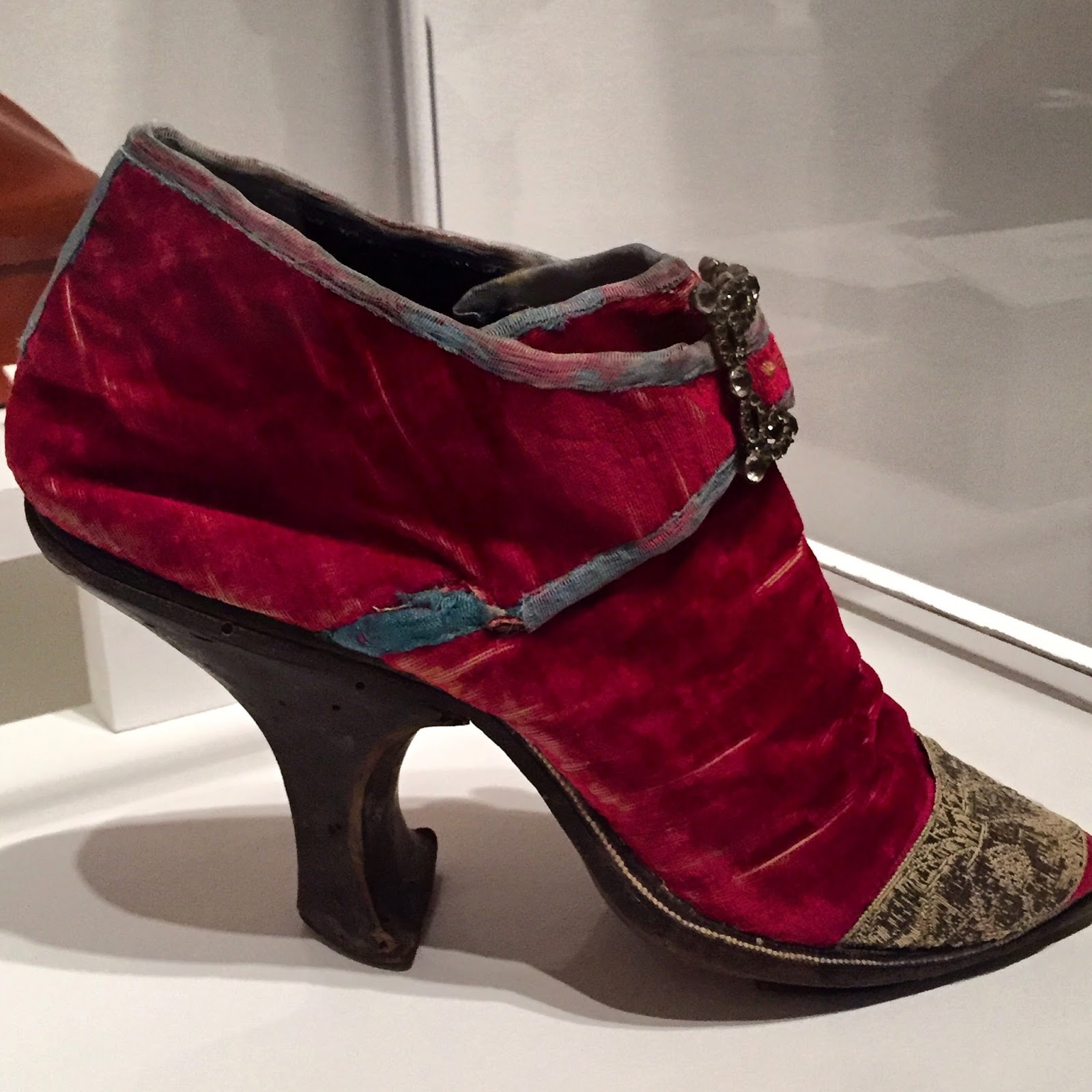
Currier After Hours: Killer Heels & the Art of the High-Heeled Shoe

Join me for a short presentation on high heels at the Currier Museum as part of a fun evening savoring shoes, music and wine. Tour the exhibit after hours. For tickets and information: http://www.currier.org/calendar/currier-after-hours-relax-and-enjoy-shoe/

Red velvet shoe with metallic lace, Italian, c. 1700-1730
Courtesy, Bata Shoe Museum, Toronto
This night is all about relaxing and exploring shoes. Sample wines from LaBelle Winery and special libations from Djinn Spirits. Learn the stories behind the world of shoes from Dr. Kimberly Alexander, UNH faculty member, and more. The evening will also include live music by MB Padfield, a cash bar and a tour of both Killer Heels and fashion accessories in art. Free with Museum general admission, $8 special exhibition charge for Not-Yet Members to view Killer Heels.

The exhibit was curated by Lisa Small of the Brooklyn Museum
Red and white gingham platform heels by Viviene Westwood
Courtesy, Philadelphia Museum of Art

Thursday, February 11, 2016

Mrs. Abigail Norman Price & Her Exquisite French Evening Shoes, 1875-1885


Ahhh – these elegant evening shoes, were made in Paris and worn by American Abigail Kinsley Norman Prince (1860-1949). As with many wealthy women of the time, she travelled to Paris, visiting the fashion houses and acquiring the latest in French fashions. Mrs. Prince’s family donated the shoes to the Metropolitan Museum in the 1960s, along with a rich collection of some 400 garments and accessories. .[1]

There are several unusual elements found in the evening shoes, indicating not only a special make, but perhaps, Mrs. Prince made certain stylistic requests from the unknown designer. The evening shoes featured ribbon work embroidery, not commonly seen on shoes. Further, the oversized satin ankle straps were unusual for the time – generally shoes were slip-ons, without straps. These details most likely indicate a special order. The quality of the shoes may also be seen in the finished edges and the stitching on the heel and instep.

1. For additional information on the family and the large donation to the collection, see: Jessa J. Krick, Senior Research Assistant: http://www.metmuseum.org/research/curatorial-research/the-costume-institute/american-woman-symposium/behind-the-scenes/prince-donation


Tuesday, February 2, 2016

Symposium: "Life and Death in the Piscataqua Region," Portsmouth, NH


Portsmouth Historic Sites Associates 12th annual Winter Symposium,
"Life and Death in the Piscataqua Region"
Saturday, February 6, 2016
10AM to 3PM
St. John’s Masonic Temple,
351 Middle Street (the corner of Miller Avenue and Middle Street)
Portsmouth NH 03801

Tickets reserved in advance are $15;
$20 at the door the day of the event
(though organizers advise that the event fills up quickly)

The ticket price includes the day-long program of four lectures, continental breakfast
and a lunch of homemade soup, bread and dessert.

This year’s program includes:       

Elizabeth Aykroyd. “The HMS America: Building a Royal Navy Ship of the Line in Portsmouth,” on the story of this ship, a model of which was the first artifact acquired by the Portsmouth Athenaeum in 1820, and its connection to the New England expedition against Louisbourg in 1745 represents an important chapter in the history of mid-eighteenth century Portsmouth. 

Jeff Hopper and Sandra Rux, “Revealing the Warner House,” presenting new research in celebration of the 300th birthday of the Warner House. 
                                   
Peter Michaud “A National Register District for Portsmouth,” on the progress of the National Register nomination, and what it will mean for Portsmouth.
                                   
Janet Polasky. “Undocumented Cosmopolitans in Revolutionary New England,” draws from Polasky’s research for her new book Revolutions without Borders:  the Call to Liberty in the Atlantic World.               
The annual event, a fund-raiser for the Portsmouth Historic Sites Associates, will also include a preview of upcoming events for history lovers, a raffle, and sales tables including some from member sites:  Historic New England; Moffatt-Ladd House and Garden, Portsmouth Historical Society (John Paul Jones House); Strawbery Banke; The Gundalow Company; USS Albacore Museum, Warner House, Wentworth Lear Association, and the Wentworth Coolidge Mansion.

The Portsmouth Historic Sites Associates partners centuries-old historic homes and vessels, some of the most important in America. Within the architectural treasures, a multitude of rooms with authentic antique furnishings reveal poignant stories of home and work in a thriving seaport community, while the historic vessels detail chapters of Portsmouth’s history afloat.

For more information go to: www.portsmouthhistorichouses.org, or visit us at Portsmouth Historic Houses on Facebook.  For more information, or to reserve a space at this year’s event, call (603) 436-8221.