Monday, July 4, 2016

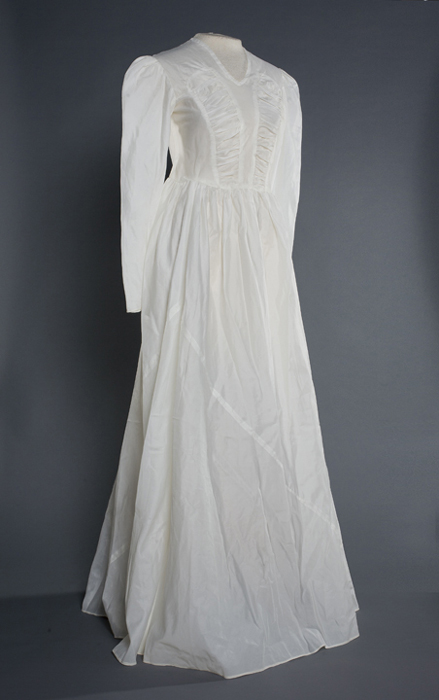
The Parachute Wedding Dress and World War II Era Brides

Photo, courtesy, Newmarket Historical Society
Sandra Tarbox (www.ColonialTable.com) and I recently co-curated a local history exhibition “I Do, I Do: Seacoast Brides Say Yes!” in Newmarket, New Hampshire. When we searched our collections and sent out a regional request for 1940s wedding gowns, we were not surprised that we had little response. Many of our parents and grandparents married just as their beloved was sent to the European theatre of war.Weddings were frequently small, hasty gatherings. And many brides shared their wedding garb with other brides, passing skirts, jackets or entire dresses along until little was left.

One of the most intriguing examples of surviving World War II wedding dresses are those made from either silk or nylon parachutes. There are surviving examples scattered in museum collections across the country. Locally, the Old Berwick Historical Society (www.OldBerwickHistoricalSociety.org)  has in its collection the wedding dress of Ruby Weston Trafton of South Berwick, which was made by Betty Trafton, the bride’s sister of a silk parachute.

Below are two stories about dresses made from parachutes, which include happily-ever-after endings. The photos and text are courtesy of the National World War II Museum and the Smithsonian Institution.

Wedding of Myrtille Delassus and Berlin, NH. Sgt. Joseph Bilodeau, 1945


Myrtille Delassus was seventeen when the Germans invaded her hometown of Merville, France. She spent four long years waiting in ration lines, cold and perpetually hungry. She could hear the Allied invasion of Normandy and, like many others, welcomed British and American soldiers when they arrived in Merville.

 GIs were generous with their surplus supplies, and one soldier, Sgt. Joseph Bilodeau of Berlin, New Hampshire, often gave items to Madame Cocque, the owner of a dress shop across the street from where he was stationed. One evening, Madame Cocque invited Sgt. Bilodeau to dinner to thank him. Since it would appear inappropriate for her to dine alone with him, she invited Myrtille, who worked in her shop. Myrtille and Joseph enjoyed each other’s company and started dating. They were married six months later on October 15, 1945, at the church in Merville.

Myrtille’s wedding dress was made from a silk parachute by the women in Madame Coque’s dress shop. It features a classic silhouette with a double ruched bodice and medium length train. For more: http://www.nationalww2museumimages.org/exhibits/war-brides/bilodeau_dress.jpg

Parachute Wedding Dress, 1947

This wedding dress was made from a nylon parachute that saved Maj. Claude Hensinger during World War II.
In August 1944, Hensinger, a B-29 pilot, and his crew were returning from a bombing raid over Yowata, Japan, when their engine caught fire. The crew was forced to bail out. Suffering from only minor injuries, Hensinger used the parachute as a pillow and blanket as he waited to be rescued. He kept the parachute that had saved his life. He later proposed to his girlfriend Ruth in 1947, offering her the material for a gown.

Ruth wanted to create a dress similar to one in the movie Gone with the Wind. She hired a local seamstress, Hilda Buck, to make the bodice and veil. Ruth made the skirt herself; she pulled up the strings on the parachute so that the dress would be shorter in the front and have a train in the back. The couple married July 19, 1947. The dress was also worn by the their daughter and by their son’s bride before being gifted to the Smithsonian. For more: http://newsdesk.si.edu/snapshot/parachute-wedding-dress

Another powerful story, which comes together through the parachute “The Wedding Dress That Made History: A Glimmer of Joy in the Displaced Persons Camp” By Helen Schwimmer

 A recent University of Cinncinati MA thesis by Carolyn Wagner entitled “Material Memories: The Parachute Wedding Gowns of American Brides, 1945-1949," is available via PDF: https://etd.ohiolink.edu/!etd.send_file?accession=ucin1428065407&disposition=inline


Saturday, July 2, 2016

Silk Brocade Shoes “For Exportation”


These dainty silk brocade shoes were made by London boot and shoemaker, Charles Chapman and exported to British America. While we do not know who owned them –the provenance has been lost—they were most likely worn in New England. 
The brocaded silk is visually appealing with pinks, pale green and raspberry tones on an ivory ground, and most likely dates to a decade or so before the actual shoe was made. Note that there was some piecing (the straps for the buckles are not matched for example) of the shoes. The style of the shoe, with its diminutive heel and placement, indicates a date range in the 1780s. They are in fine condition.
Fortunately, the survival of a label affixed to the footbed of the shoe reveals that the maker was located at 80 Cornhill in London and his business made shoes for retail shoppers as well as for export. Alas, other details regarding these shoes are lost to us at present.
The shoes are in the collection of the National Society of the Colonial Dames of America, in Boston and all photos are courtesy of the NSCDA. The author appreciates the generous assistance of Nancy Lamb, Chair of the Costume Committee, and Becky Putnam, for the invitation to speak at the Society’s Beacon Street headquarters on these, and many other shoes in the collection, February 2016.

Saturday, June 18, 2016

Cake, Croquet and an 18th Century Afternoon

Cooper Ron Raiselis, in banyan & cap made by Tara Raiselis
It was just one of those perfect early summer days in June --a cheerful, convivial atmosphere, great friends old and new, a lush garden, with flowers in bloom and splendid costumes-- all set against a backdrop of a very special and significant historic house. The 1716 brick MacPhaedris-Warner House, a merchant's home, in Portsmouth, New Hampshire, could just as easily be found in or around London. And yet, here the house stands, near the Piscataqua River. 

The third annual “Cake & Croquet: An 18th Century Afternoon” is a perfect accent to the theatricality of this Baroque survival. From croquet and Scottish country dancing on the lawn, to quiet conversations over tea and cake, the images below capture the day. Perhaps you will join us next year….

The Koski family and friend Hannah


Tara and Ron Raiselis
Jeffrey Hopper, Historic House Manager
All photos by the author 
For additional information about the Warner House, www.warnerhouse.org

Thursday, June 9, 2016

Archibald MacPheadris and His Room: A Baroque Merchant's House, 1716

Ascending the stairs
Archibald Macpheadris built his house on the shores of the Piscataqua River in 1716. The house is a fine example of a London style late baroque merchant’s house—rare enough in England, but exceptional in the United States.  Over time, the processional essence of that world has been lost, but in anticipation of the 300th anniversary of the building of the house an attempt has been made to remember and display how that theatrical world influenced, but did not wholly shape the present. A mode of life that was taken for granted disappeared in a historic instant—leaving only the rooms that accommodated the private/public stage of the everyday.

Talk & Cheese


Over the centuries this small chamber has been used as a bedroom, closet and in this example, its earliest use, as a study, or private chamber. In 1718 this room was at the heart of the public area of the house. Guests were entertained on the second floor in both the “smalt” room with its sprung floor for music and dancing and in the southwest bedchamber, where the most important guests were received. Due to its location and size, this room provided Macpheadris with a private study near his family, a place to instruct and engage his business staff, to display special wares and exotic items from his travels for his clients, and a separate area for his role as a member of the King’s council for New Hampshire.

Silk & Wool & Mat


This small room was a microcosm and center of Macpheadris’s mercantile world—poised between the early period of colonization and the growing prosperity of the eighteenth century. It was a world comprised of English wool, glass, furniture, engravings and pewter, Asian ceramics, a chest of drawers from nearby Saco, Maine, Virginian tobacco, Irish cheese, Spitalfields’ silk from London, woven mats, from the Mediterranean, and Port and Madeira from the Iberian Peninsula.  This was the British Atlantic world of the early eighteenth century and Macpheadris and other Portsmouth merchants were active participants in it.

Clay & Wood


The room was pivotally located so that with the door open it overlooked the social center of the house. With its turned balcony, walls decorated with murals, and a large weight-balanced glazed window it was a space of determined urban sophistication. To complete the impression, in 1718 the view looking across the street through the room’s front window would have included the gardens and large wooden shop, warehouse and guest quarters that sat next to it. Anyone entertained in this room would have understood Macpheadris’s social standing and aspirations. However, styles changed. When his daughter, Mary, and new husband, Jonathan Warner, took possession of the house in 1760, this room and all the others on the second floor retreated forever into the private household.

Passing Scenes of Importance, Once Meaningful, Now Obscure

Jeff Hopper manages historic properties and writes about history, architecture and clothing, among other things. 

Monday, May 30, 2016

A Pair of Festive Silk Brocade Pinet Evening Shoes


Collection of the author
Photo, K. Alexander
These elegant Francois Pinet (1817-1897) evening pumps, c. 1920 are included in my (very) modest study collection.  (The business continued after the senior Pinet died.) They feature a festive, sparkly silk brocade upper with leather sole and heel covered with the same textile as the shoe. They boast the ‘F. Pinet’ label, as well as “Pinet” stamped into leather sole.  


Just about as wonderful as the shoes themselves, however, is the survival of the original box, which probably accompanied them home with a very happy owner.
Pinet, the son of a shoemaker, made many contributions to the field of late 19th Parisian ladies footwear. His elegant boots of the 1870s-1880s were high style designs perfectly at home paired with a Worth gown, for example.
Pines satin lace up boots, c. 1870
Courtesy Bata Shoe Museum
The attention to detail, in particular the balanced design, makes these appear quite comfortable – but I will never know, as I have no intention of trying them on! 

 For additional information:

The Art of the Shoe, Marie-Josephe Bossan, 2004, p. 67


Friday, May 6, 2016

Future Fashions

Courtesy, Museum of Fine Arts, Boston
Photograph @Kimberly Alexander
I recently had the opportunity to spend time at both the Currier Museum (www.currier.org) and the Museum of Fine Arts, Boston (www.mfa.org), pondering the current and future ramifications of technology and material in the current fashion marketplace. How do post-consumer recycled materials, fused fibers and 3D printing change not only the look and possibility of an evolving “fashion”? How does this alter the availability of items such as shoes for world cultures in need of footwear – whether the need be created by poverty, famine, or natural disaster? How do new technologies free the body or respond to the environment? Of course, there are hardly new questions, but if you are interested in making your own exploration, I encourage you to visit #techstyle at the MFA Boston and “Killer Heels” at the Currier Museum (on view until 15 May 2016; http://www.currier.org/exhibitions/killer-heels-art-high-heeled-shoe/).

There are a number of fascinating garments included in #techstyle, but I have selected just a few, in large part because my predilection is for an exploration of how past dress iconography is envisioned in new materials and with relatively recent technologies.


One of the best known garments in the exhibition is the “Anthozoa” cape and skirt. Curious about the title, I did a bit of research and discovered that anthozoas are from the family of sea anemenoe and corals. They can be brightly colored, vary in size and live singly or in a colony. Taken in this context, the dress and cape is all the more paradoxical – using the natural form of a sea creature as the basis of a design which is created by predominately man-made materials.

Iris van Herpen and Neri Oxman
Anthozoa 3D cape and skirt from the Voltage Collection, 2013
Polyurethane rubber and acrylic co-polymer 3D printed on Stratasys Connex 3D printer, steel cage, cotton twill, silk satin

Manish Arora known for combining “traditional Indian crafts like embroidery, applique , and beading with Western silhouettes.”  The bodice, which was look #33 from his Spring/Sumer 2013 collection is a fusion of traditional clothing with modern technology; here the laser-cut leather is embroidered with beads and sequins.

Finally, both exhibitions plumb shoe typology and technology in work of the late Zaha Hadid for NOVA and the botanically-inspired shoes of Iris Van Herpen and Rem D. Koolhaus, United Nude.


For more: