Showing posts with label Boston. Show all posts

Wednesday, August 8, 2018

An 1879 Wedding Dress Designed by Madame Shepherd of Boston

All images are courtesy of the NSCDA-MA
This striking silk satin wedding dress was designed by a Boston dressmaker, Madame Shepherd. Her studio was located in the Hotel Pelham, a fashionable French flat residence.  Madame Shepherd appears in the Boston City Directories over a number of years, listed under “Dressmakers.” 


Although the wedding dress appears as a two piece ensemble of bodice and skirt, it is in fact constructed in one piece. Worn on November 5th, 1879, the balance between pleated upper bodice, the high neck trimmed with lace, and the floral patterned silk skirt, embellished with beads and faux pearls, is dynamic. The silk, the details, and the quality of the dressmaking are excellent. 


The wedding dress and the accessories shown here are from the NSCDA-MA Costume Collection, Accession Number MA-CC-1953-13A. For more, contact https://nscdama.org

The author thanks Rebecca Putnam and the members of the costume committee for their assistance.

Sunday, August 23, 2015

John Hancock's Table: Turtles, Pineapples and the Paradoxical Politics of 1768

You will always find items both useful and intriguing at the Massachusetts Historical Society (www.masshistory.org). One tasty tidbit, from the Hancock family papers, is a bill of sale dated 27 June 1768, from Oliver Wendell of Boston to John Hancock. It is bill for six turtles (a weight of 234 pounds) and eighteen pineapples. The total bill came to 16 pounds, 19 shillings. Such exotic fare was shipped from the West Indies and sold (usually dockside) to inns and tavern keepers and representatives of wealthy clientele in Boston, Philadelphia, Charleston, and so on.  

Courtesy, Massachusetts Historical Society, Hancock Family Papers


During the late 18th century & into the 19th,  Mr. Julien promoted the many benefits of turtle soup to his Boston clientele.
These were heady days for Hancock, caught up in the events that would lead ultimately to the Revolution and independence from Great Britain.  By the late spring of 1768 (with the Lydia/Liberty incidents unfolding), Hancock was allied with Samuel Adams and the Sons of Liberty in organizing resistance to the new taxes imposed on America in the infamous Townshend Duties.  In May, he had been elected to Governor Francis Bernard’s Council, the upper house of the Massachusetts legislature, only to have the people’s choice vetoed by Bernard.  Still, that same day, voters elected him to the House of Representatives.  Two weeks later, he would be elected Major of the Cadets, a new branch of the Massachusetts militia.

Such honors required a gentleman of Hancock’s station to demonstrate his gratitude through celebratory banquets and fetes.  That Hancock was planning festivities at this time of some sort is evident in Oliver Wendell’s bill for exotic fare, especially as the bill appears to several imposing sea turtles, no doubt to be served as a delicacy - turtle soup . Pineapples too had been long associated as luxury items and their appearance at Hancock's table would have heightened the sense of it being a significant celebration. Hancock's uncle, Thomas, had died by this time, leaving the 'Hancock Mansion' to his nephew-- a perfect place for entertaining with his Aunt Lydia as hostess.


For further reading:
Two excellent articles - and everything you could want to know about turtle and mock turtle soup from the University of Pennsylvania Museum:

and Uncovering Hidden Lives: 18th Century Black Mariners:


Thursday, September 25, 2014

The Hancocks of Boston in Wool, Silk & Linen

 
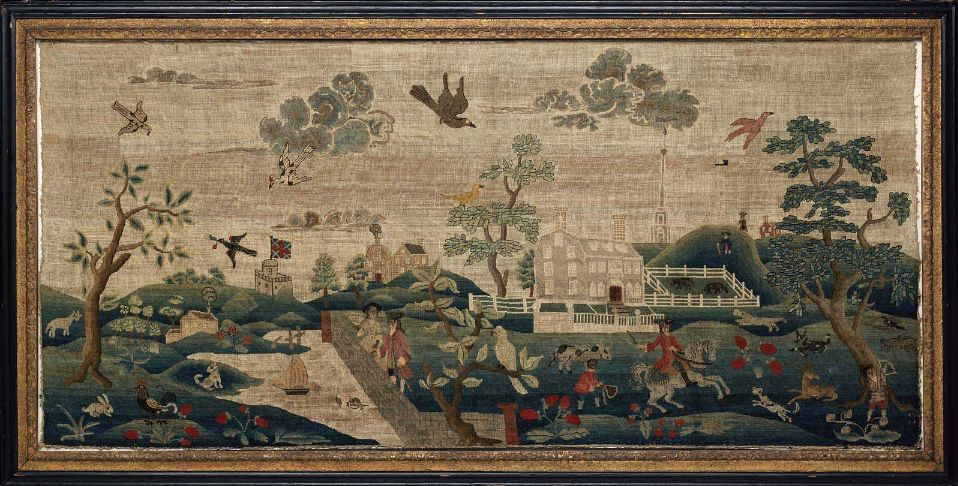
Hannah Otis’s (1732-1801) sampler “View of Boston Common” (c. 1750, Museum of Fine Arts, Boston) is a charming and significant pictorial narrative, capturing life in Boston prior to the Revolution.  The connection of the sampler to a significant New England family, the documentary nature and large over-mantel size all serve to distinguish it as a preeminent example of school girl skill and, in this case, creativity. It is embroidered in wool and silk on a linen canvas.
This sampler is a delight, and the more time one takes to examine it, the more one sees. Note the British flag waving energetically above the pre-Revolutionary blockhouse, for example. Of particular interest is the representation of the impressive Georgian style Hancock Mansion (demolished in 1863) with its fences, orchards and parterres. The elegant occupants are enjoying the bountiful and exuberant landscape, peppered with unusual birds, animals and over scaled plantings, which  Hannah Otis has created for them.  The couple standing near the wall (just to the left of center) were most likely Thomas Hancock (1703-1764) and his wife, Lydia Henchman Hancock (1714-1776), with their stately home and grounds as a backdrop. Thomas Hancock wears a long red (?) coat with substantial cuffs, a waistcoat, breeches with white hose, and what appears to be a tricorn hat. Lydia Hancock is dressed in the elite fashion of the time, sporting a light colored dress (probably silk) and stomacher.
Thomas Hancock was John Hancock’s uncle. Known as a very wealthy merchant (as well as a probable smuggler) and head of the “House of Hancock,” he opened his home and business to his orphaned nephew, John. Indeed, it would not be surprising if the lad on horseback, with a black liveried groom, depicted in Otis’s sampler was in fact the adolescent John. Born in 1737, he would have been around thirteen years of age. Like his aunt and uncle, young John wears appropriate, fashionable clothing. He is clad in riding gear, including high leather boots.


Detail, Thomas Hancock, 1730, by John Smibert
Museum of Fine Arts,  Boston
Lydia Henchman Hancock, by John Singleton Copley
National Portrait Gallery
For more, see The History Blog http://www.thehistoryblog.com/wp-content/uploads/2012/01/View-of-Boston-Common-Hannah-Otis.png
“The most expensive sampler ever sold is View of Boston Common by Hannah Otis (1732-1801), stitched around 1750. It’s a huge piece, meant for display over a chimney mantelpiece, embroidered in wool and silk on linen canvas. It was purchased by the Museum of Fine Arts, Boston at Sotheby’s in 1996 for a record $1,157,500.
Hannah Otis is closely linked to the American Revolution and American history in general. She was born in 1732, the daughter of Colonel James Otis and Mary Allyne Otis. Her mother was a descendant of Mayflower passenger Edward Doty. Her father was a judge and representative to the Massachusetts legislature. He was a fervent anti-royalist as was his son, James Otis, Jr., who introduced the phrase “Taxation without representation is tyranny” during the Stamp Act debates. Hannah’s older sister Mercy Otis Warren was a poet, playwright and historian who published numerous pro-Revolution writings and corresponded with the luminaries of the American Revolution like John Hancock, Thomas Jefferson, George Washington and John Adams.

The sampler remained in the Otis family until the 1996 sale. It had been on loan at the Boston Museum of Fine Arts for over 40 years when the family decided reluctantly that they had to sell it.”

Thursday, April 17, 2014

The Unfortunate Tale of Boston Shopkeeper Henrietta Maria East Caine, 1750s


Seeking new financial opportunities as a single woman, Henrietta Maria East arrived in Boston from London in 1743 with a rich stock of textiles (such as the c.1750 Spitalfields silk from the Metropolitan Museum, above) and other goods. She opened a millinery shop in the heart of the town, on Marlborough Street. Judging from the advertisements she placed over time in the Boston Post Boy and other newspapers as well, she kept a well-stocked shop of prized textiles and accessories.

An ad from 1750 made it clear that she had all the latest and most fashionable goods from London. She carried everything from fine silks, to tabby stays and London shalloons – items in demand from Boston residents. (Advertisement, courtesy American Antiquarian Society.)

As recounted in Patricia Cleary’s noted 2000 publication, Elizabeth Murray: A Woman's Pursuit of Independence in Eighteenth-Century America, Henrietta’s  decision to marry in 1747, had devastating consequences for the young entrepreneur. Cleary reveals that Henrietta married Londoner Hugh Caine, who, as it turned out, was already married and had a wife at home. Not only a bigamist, he abandoned Henrietta in 1751, helping himself to her hard earned property.  She would later reveal that during those four years of marriage she sustained his violence toward her. Unfortunately, Hugh Caine's departure did not end the problems caused by the marriage. Henrietta Maria East Caine remained legally responsible for all of his debts and found merchants unwilling to trade with her because of her connection to a bigamist, despite his departure. The legal bonds that women experienced with marriage limited her ability to act independently. Eventually, she turned to the courts to dissolve her marriage, but once again, met without success. She was literally trapped by the legal system and her ultimate demise was not a happy one as you might expect.

Although of little comfort to Henrietta, today’s textile, costume and material culture scholars will find great interest in the items which were auctioned to cover her debts. Running to four full pages, every ribbon, button and remnant was cataloged for sale. Bundles of "babies Rowlers," women's tabby stays, scarlet calamanco, every imaginable silk and even the odd wig, were up for sale. Even some of Henrietta's household items were included at the close of page four. It is not currently known how much was realized at auction or if she regained solvency. To view the entire inventory as listed for sale in 1754 (from the Massachusetts Historical Society Collections): Henrietta Maria Caine, Catalog of Auction Goods, Boston-1754


For more on Henrietta Maria East Caine's life and career, see Patricia Cleary, Elizabeth Murray: A Woman's Pursuit of Independence in Eighteenth-Century America (Amherst: University of Massachusetts Press, 2000), 45-46, 57, 60, 62-63, 241n.


Monday, January 6, 2014

A Winter Supper with Dorothy Hancock's Plain Yeast Rolls

Dorothy Quincy (Hancock), c. 1772
John Singleton Copley
Courtesy, Museum of Fine Arts, Boston
Dorothy (Dolly) Hancock (1747-1830) was a gracious and tireless hostess, a key position in the strategic operations of any political household past or present. Currently researching a post on Mrs. Hancock's fashionable ensembles, I was sidetracked by wintery cold weather. Mulling over what it must have been like to entertain in the "Hancock Mansion" on Beacon Hill, Boston, during the heady times following the American Revolution, I came across a recipe for her plain yeast rolls. It was adapted by Robert Pelton in his 2004 publication "Baking Recipes of Our Founding Fathers." I appreciate the many learned and skilled hearth cooks and culinary historians, who recreate the food of our ancestors through scholarly research, and care. I am merely a dabbler and I make no pretense of detailed knowledge in this arena  This post is simply about connecting food with historic events, places and people - and to try something new today. 
The Hancock "Mansion" in snow, c. 1860 (Demolished 1863)
Courtesy, The Trustees of the Boston Public Library
Contemporary accounts noted that theIt was noted prior to demolition that the west wing was used for the kitchen and other domestic functions. 
Some of my favorite observations regarding the couple's entertaining -- a harried, overworked cook on the verge of collapse, an unexpected dinner for several hundred French visitors, which required Mrs. Hancock to declare all the cows grazing on the Common be milked -- were made in 1854 by William Sumner (from his conversations with Mrs. Hancock) and appear in J.L. Bell's article "Dorothy Hancock: Political Hostess" (http://boston1775.blogspot.com/2006/11/dorothy-hancock-political-hostess.html)


I am making a roast chicken with root vegetables tonight and, time permitting, plan to try out her recipe for rolls. Will let you know if there is approbation around the table.

Dorothy Hancock's Plain Yeast Rolls
4 cups milk, warm
¼ cup yeast
5 cups flour
1 egg, well beaten
2 Tbsp butter
1 tsp salt
1 Tbsp sugar
½ tsp baking soda
Flour to suit

Make sponge by blending milk, yeast and flour in large wooden mixing bowl. Cover bowl with thick towel or cloth. Set aside in warm place to rise. When light (risen), stir in beaten egg, melted butter, salt and sugar. Dissolve baking soda in a little hot water and add while stirring. Put in sufficient flour to make soft, pliable dough. Cover as before and set in warm place to rise for about 4 or 5 hours.

Roll these out to ½" cakes. Fold cakes, not quite in center, like turnovers. Or simply shape with hands into balls. Set cakes or balls close together on shallow, buttered pan. Cover once again and set aside in warm place. Let dough rise a third time for about one hour.

When risen, cut deeply across top of each roll with sharp knife. Put into quick oven (425 degrees). Bake about thirty minutes or until tops of rolls are lightly browned.


SOURCE: "Baking Recipes Of Our Founding Fathers" By Robert W. Pelton accessed online at: http://www.books.google.com.


Sunday, December 29, 2013

Icy Blue Silk & Feathers: Two Wintery Victorian Garments, 1870s-1880s

Two Victorian garments recently caught my attention – both are of a pale, icy blue silk, trimmed with soft white feathers, perfect for winter entertainments and galas attended by the late 19th century elite.  
The Gown:

This fluffy, feminine evening gown of icy sky blue & gold silk, trimmed with feathers (perhaps eider?) is labeled "R.H. White & Co." one of Boston's premier shopping destinations well into the 20th century. This well-designed head-turner was created during the 1880s. The feminine evening gown features a light palette, popularized after the 1876 Centennial Exposition in Philadelphia as "Colonial." Further, note the treatment of the gown construction, with a nod to the "petticoat." The designer was looking back to the garments of the previous century for inspiration. Perfect for evening Victorian soirees, can’t you just imagine its wearer making an entrance, all eyes turned upon her?

Metropolitan Museum of Art, Accession Number 2009.300.1803


The Dolman:

Looking for another little statement to adorn your holiday attire? How about an frosty blue silk dolman? Intriguing and attractive garment from a skilled, but anonymous Victorian designer. Look at that sleeve! Ornamented with extensive metallic silk trim (with a militaristic bent) and soft feathers which together create a sort of ying/yang effect. Note the substantial quilting which would have afforded some warmth. This is an American piece c. 1871.


Metropolitan Museum of Art, Accession Number 1979.346.96

What accessories would you select? A feather muff or fan?


Tuesday, September 24, 2013

"Welcome, little stranger..though the port is block't up 1774" - Mary Rand's Pincushion


It was Thursday, June 3rd, 1773, when Mary Simpkins married Robert Rand in Boston. Mary’s father, William (1704-1780), was a well-known jeweler and silversmith. Rand was a Boston merchant, from an established family. Despite the fact that the Boston Tea Party was a mere six months away and her husband took part in militia activity in Bedford, Mary (b. 1754 ?) wore wedding shoes from London. She was most likely quite pleased with her stylish cream-colored silk shoes, brocaded with pink and green flowers. The label reveals that they were made by the cordwainers “Jno. Hose & Son. At the Rose in Cheapside near Milk Street. London.”  Clearly a treasured family heirloom, they were passed down to her daughter and eventually, found their way to the collections of the Connecticut Historical Society. 

John Hose, c. 1773
Connecticut Historical Society, Object Number: 1953.16.0a,b
Mary Simpkins Rand Wedding Shoes

About a year after their marriage, Mary and Robert welcomed their first born--a daughter. The child did not survive and was buried at the Granary Burying Ground, according to family sources. 
http://www.ma-roots.org/books/hearth/chapter23.html
Rand Family Collections

A poignant memento survives from this troubled period in Mary's life. The soon-to-be or new mother made a pincushion for her firstborn; it bore the inscription: "Welcome, little stranger, to Boston, though the port is block't up 1774." It was a token to her new role as mother, but also to the tumult of revolutionary politics.  Enraged over the Boston Tea Party, Parliament had passed the Boston Port Act in March, and the Royal Navy had formed a blockade around the port of Boston.  Patriot families fled the city, as Boston’s population fell from some 15,000 to fewer than 3,000.  Mary was one of those who fled the besieged city. While Robert fought against the British, serving as sergeant of the Bedford minutemen at Concord in April 1775, Mary went to Chelmsford, Massachusetts. She did not return to Boston until sometime in 1777, after Washington’s artillery forced the British forces to move on to New York.

In her flight to Chelmsford, Mary had to cross British checkpoints, where suspicious British soldiers examined the few personal items that frightened Bostonians could pack.  For the grieving mother, few items were more precious than the modest keepsake that held the memory of her lost child. The image posted here is from family collections.

Today, even after a period of over two centuries, we can relate to Mary’s feelings of both joy and sadness, represented by these treasured family artifacts.