Showing posts with label embroidery. Show all posts

Monday, December 27, 2021

Rachel Adams and Fragments of Her Embroidery, c. 1789

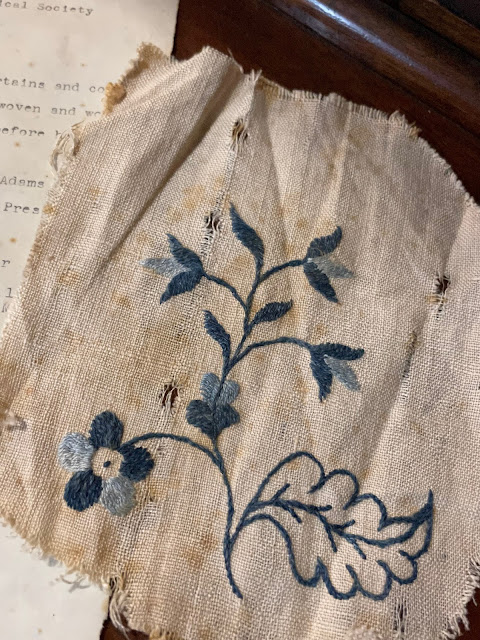
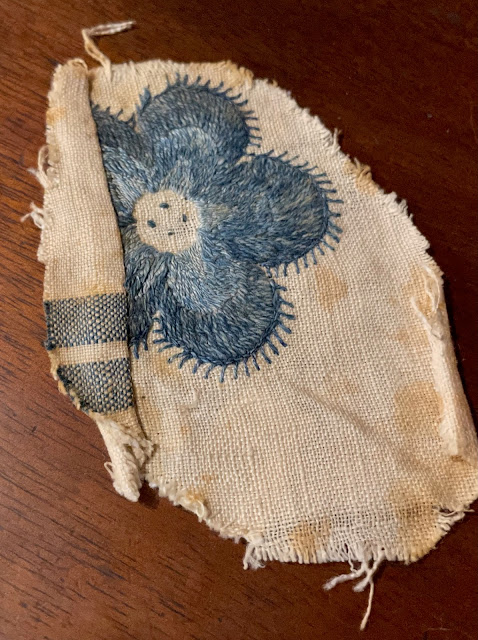
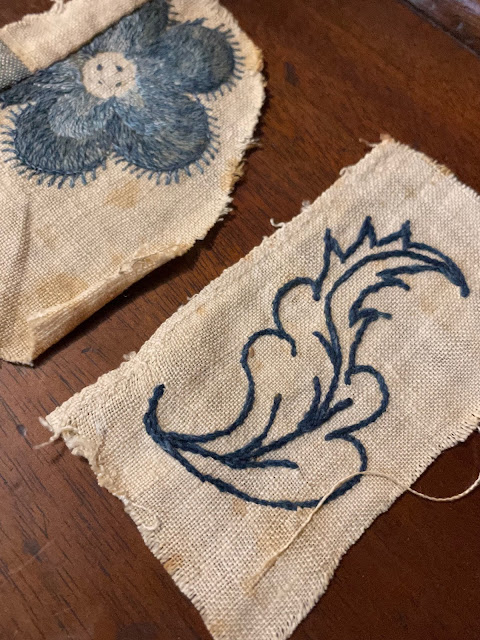
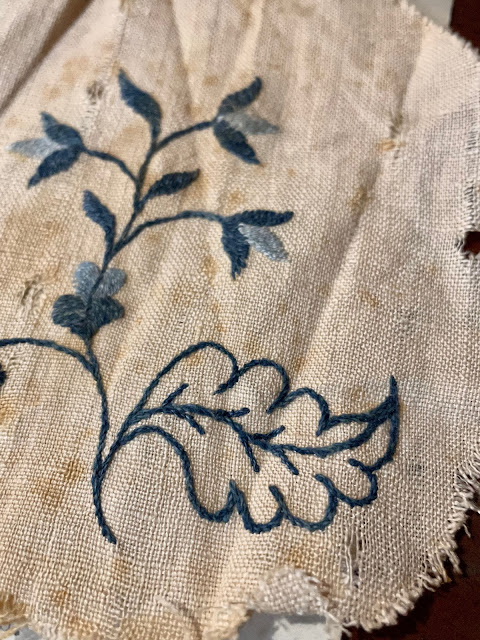
Tucked away safely in a dresser drawer in the Stone School Museum of the Newmarket Historical Society (New Hampshire) are several fragments of what were most likely bed hangings (the donor notes for a canopy bed), made of homespun, hand-woven linen and embroidered with delicate floral motifs, predominately in shades of blue.

The four small pieces of well-worn textiles were donated to the Historical Society on February 14th, 1968 by a descendant of the maker who “vouched for” its authenticity. The label which accompanied the gift notes that the textile was “spun, woven and worked by Rachel Adams of West Medway before her marriage. About 1789.” Her father was Revolutionary War officer, Captain Moses Adams.


Although there remain genealogical issues to work out, the details regarding the actual textile align – the use of small scale motifs and limited palette certainly reflect the visual aesthetics of the last quarter of the 18th century. Further, the tradition of ‘going to housekeeping’ meant that many females of the time created useful household items related to bedding to take into their new home after marriage.

All photos by the author; courtesy, Newmarket Historical Society


Sunday, November 18, 2018

A Baptismal Apron Embroidered by Mary Woodbury, c. 1735

I thought you might enjoy the story connected with this baptismal apron, c. 1735. Currently on view in Fashioning the New England Family at the Massachusetts Historical Society (10/2018-4/2019; www.masshist.org), it was embroidered by Mary Woodbury (1717-1748) of Beverly, Massachusetts.[1] 
All images are courtesy of the Massachusetts Historical Society; photographer, Laura Wulf.
Using familiar 18thcentury iconography inspired by Asian motifs -- vases/urns of exotic flowers, flying phoenix/hoho birds--it is replete with silk and metallic threads, as well as small spangles. The primary stitches are flat and satin stitches. The colors are still bright against an extremely fragile silk ground. Born on March 3, 1717, the maker may have attended a female academy in Boston. 


She married Dr. Benjamin Jones on March 3, 1736/7.  She died the day before her 31stor 32nd  birthday. The baptismal apron was most likely made for her own child, embroidered when Mary was around age 18-19. After her death on March 2, 1748, her belongings were carefully saved for her daughter, Lydia, by Dr. Jones' second and third wives.  Lydia later married the Rev. Thomas Lancaster, who was minister of Scarborough, ME. from 1775 to 1831.

A baptismal apron such as this one, was worn by the infant. The term "apron" appears to be used in the 17th century and into the early 18th. Changes in baptismal practices - the move away from full immersion -- allowed for the better known Christening dress or gown to supplant the earlier ensemble, which often included the apron, a bib, mitts, and cap. The use of bearing cloths in the 17th and 18th century was also common. The example embroidered by Mary Woodbury has proportions closer to the apron than the square bearing cloth. Further, her family had settled in Massachusetts in the 17th century, likely continuing the practices from home. A full ensemble from the Victoria & Albert Museum may be seen here: ‪react-text: 204 Victoria and Albert Museum /react-text :‪react-text: 207 http://collections.vam.ac.uk/.../baby-clothes-unknown/


1. Accession # 0168
Given by the grandchildren of Dorothy Lancaster Libby, through Charles Thornton Libby of Portland, ME, on August 5, 1931.
References   MHS Proceedings64; 346

2. A second, and very unusual, example of her work, also survives at the Massachusetts Historical Society – a painting of Pocahontas. This may well be the first representation of Pocahontas by a woman. For more, see https://www.masshist.org/database/1747


Friday, August 4, 2017

Two Views of the Same Georgian Shoes, c. 1730-40s

I have long been enamored of these cheerful, chipper shoes, housed in the collection of the Victoria and Albert Museum. They are visually pleasing with a balanced design. These linen canvas shoes are embroidered with colored wools in cross stitch and tent stitch, and feature a short heel and latchets (or straps) for buckles to fasten them. From Great Britain, c. 1730s-40s; the wearer and maker are unknown.
As I prepare to curate an exhibit at www.MassHist.org in 2018, I have been thinking a good deal about photography and presentation of costume over time. I find both the V&A and the Metropolitan Museum good sites for such exploration as they have been documenting their collections over an extended period of time. I will be returning to this theme over the next 18 months, but thought you might enjoy considering your response to these two photographs of the same shoes. Does the photographic style change or influence your response? Do you have a preference between an artistically photographed vision and the more documentary style? Note the wear apparent at the heel and the toe; the turned up, pointed toe; the white rand, and the straps for buckles are much more visible in the second photo. There is drama associated with the single shoe which appears suspended in a beautiful blue backdrop, and with its saturated color, may appeal to contemporary audiences. Both images convey different features and qualities – some which may appeal more to one audience over another.  Taken together, the differing photos provide a fuller portrait.

For more, see the Victoria and Albert Museum: http://collections.vam.ac.uk/…/O74390/pair-of-shoes-unknown/


Friday, April 1, 2016

Inspired by 1775 Embroidery Patterns: The Lady's Magazine Stitch-Off

The Lady’s Magazine project (housed at Kent University) recently embarked upon a major undertaking – a stich-off! While there are many different aspects to this multi-faceted project, I was intrigued by the appearance of a 1775 embroidery pattern for shoes. Women were creating their own uppers which were then attached to a cordwainer’s ‘leather,’ meaning his sole and heel, as well as purchasing those professionally produced.


Once the generous owner of the privately held pattern made it available, the creative Dr. Jennie Batchelor threw down the gauntlet and inspired ‘stitchers” deftly created some stunning pieces.


I have had the good fortune to follow the work of the talented Nicole Rudolph over the last few years (to see more of her fascinating projects, see www.DiaryofaMantuaMaker.com). When she turned her talents to the project --- well, you can see the results for yourself. As the label notes:"These shoes have been constructed using historical tools and techniques in a style that would have been popular around 1775 when the pattern was printed. They are made from figured silk taffeta and satin, embroidered in unspun silk.


To place the work in context, you will find many extant museum examples – below find a few:
A later example, c. 1780-90
Courtesy, Manchester Art Gallery
Blue figured silk, c. 1776, European
Courtesy, Metropolitan Museum
Figured silk shoe, made in Massachusetts, c. 1780s
Courtesy, American Textile History Museum; Author photo

Thanks to the efforts of many, you can now view examples from the Lady’s Magazine stitch off on view at Chawton House as part of the ‘Emma at 200: from English Village to Global Appeal’ exhibition.

For the latest:
@ChawtonHouse
@ladysmagproject
@colevintage


‘Emma at 200: from English Village to Global Appeal’


Friday, November 15, 2013

Cotton, Linen, Silk, Wool: Celebrating Fiber Arts at Historic Deerfield

This past weekend, while visiting my older daughter at UMass-Amherst, I had the opportunity to spend a truly exceptional afternoon at Historic Deerfield (Deerfield, MA), attending the "Celebrating Fiber Arts" exhibition.  Located in the Helen Geier Flynt Center, I had reason to anticipate a delightful excursion through these collections.  On a previous visit in 2011, I had presented a paper on Georgian architecture and design at the annual fall symposium.  More recently, I visited the textile collection and immersed myself in the fabulous footwear for my current research on Georgian shoes in Colonial America.

            This visit was decidedly different: I was there to savor, discover, and, simply, enjoy. No time frame or pressing goals to be met. No one else present in the gallery, leaving me the opportunity to immerse myself in the surroundings without the need to jostle for a perch. So many aspects of this installation and its rubric of space make it noteworthy. I find compelling the fact that the primary textiles associated with historic garments have been organized thematically: cotton, linen, silk and wool. Within this format, the curatorial staff introduces select items or recent acquisitions each season, on a rotating basis. This was my second visit to the "rotation," and I found it just as interesting as the first. While I enjoy blockbuster fashion exhibits as much as anyone, the intimacy of the space and the careful – might I say reverential? - selection of objects (38 according to press materials) allowed the liberties of close inspection and reflective inquiry. Despite working closely with museum collections for over 25 years, I felt as though I was making new discoveries with each step.

Do put this in your planner – the exhibition closes on December 29th!

A few of my favorite "interactions." All photos are courtesy of Historic Deerfield (www.Historic-Deerfield.org) and a list of captions may be found at the end of this post.


And the shoes? Stay tuned…


The author thanks Ned Lazaro, Collections Manager and Associate Curator of Textiles, for his assistance.

Illustrations:
- Court dress, blue & white silk brocade, woven in Lyon, France, c.1760. Note expansive panniers.
- Detail, blue & white silk brocade Court dress with "fly” or floss fringe, c.1760.
- Man's early 19thc. linen plain weave shirt. Fabric, probably England; garment, probably American.
- English or American corset, 1820-1830, bleached satin weave cotton and twill weave cotton tape. The grommets are of ivory. Acc.# F.310
- Ladies' wallet or pocketbook (1750-1800) is rare in that it is attached to a known maker, Rebecca Kingsbury (1713-1807) of Dedham, MA. Rebecca was a schoolteacher in the 1730s before marrying Nathan Gay in 1740. Wool, silk, linen & pasteboard.

###  #### #### #### #### #### #### #### #### ###
Historic Deerfield’s costume and textile collection has long been considered one of the finest in America.  Begun by the museum’s founder, Helen Geier Flynt, the collection features a vast array of costumes, needlework and domestic textiles which are displayed on a rotating basis.  Newly installed in this permanent gallery for the season are 38 exciting examples of American and European clothing, accessories, textiles and needlework from the 17th century through the mid-20th century.   

See more at: