Showing posts with label john hancock. Show all posts

Friday, August 28, 2015

Dolly Hancock: Romance, Wedding Shoes & Revolution, August 1775


His choice was very natural, a granddaughter of the great patron and most revered friend of his father. Beauty, politeness, and every domestic virtue justified his predilection.
--John Adams on the marriage of Dorothy and John Hancock
Dolly Hancock's London-made wedding shoes. Courtesy, The Bostonian Society
Dorothy Quincy and John Hancock married August 28, 1775 at Fairfield, Connecticut, the Thaddeus Burr estate. Their wedding was held against the backdrop of the start of the American Revolution. According to family tradition and based on the style of the shoes, it is possible that she wore these delicate London-made, cream silk, low-heeled shoes. The cordwainers were Bragg & Luckin.. 

Their wedding occurred while John was on recess from 2nd Continental Congress in Philadelphia, where he oversaw the war effort as President. John's widowed aunt, Lydia Henchman Hancock, was a close friend of the Burr family and spent much time at their estate. Evidence suggests she played a major role in overseeing the relationship and encouraging the marriage.


For more on the wedding and the Burr Estate, see "Burr Mansion: A Love Story" by Cathryn Prince, November 2013 in http://allthingsliberty.com/2013/11/burr-mansion-love-story/

Sunday, August 23, 2015

John Hancock's Table: Turtles, Pineapples and the Paradoxical Politics of 1768

You will always find items both useful and intriguing at the Massachusetts Historical Society (www.masshistory.org). One tasty tidbit, from the Hancock family papers, is a bill of sale dated 27 June 1768, from Oliver Wendell of Boston to John Hancock. It is bill for six turtles (a weight of 234 pounds) and eighteen pineapples. The total bill came to 16 pounds, 19 shillings. Such exotic fare was shipped from the West Indies and sold (usually dockside) to inns and tavern keepers and representatives of wealthy clientele in Boston, Philadelphia, Charleston, and so on.  

Courtesy, Massachusetts Historical Society, Hancock Family Papers


During the late 18th century & into the 19th,  Mr. Julien promoted the many benefits of turtle soup to his Boston clientele.
These were heady days for Hancock, caught up in the events that would lead ultimately to the Revolution and independence from Great Britain.  By the late spring of 1768 (with the Lydia/Liberty incidents unfolding), Hancock was allied with Samuel Adams and the Sons of Liberty in organizing resistance to the new taxes imposed on America in the infamous Townshend Duties.  In May, he had been elected to Governor Francis Bernard’s Council, the upper house of the Massachusetts legislature, only to have the people’s choice vetoed by Bernard.  Still, that same day, voters elected him to the House of Representatives.  Two weeks later, he would be elected Major of the Cadets, a new branch of the Massachusetts militia.

Such honors required a gentleman of Hancock’s station to demonstrate his gratitude through celebratory banquets and fetes.  That Hancock was planning festivities at this time of some sort is evident in Oliver Wendell’s bill for exotic fare, especially as the bill appears to several imposing sea turtles, no doubt to be served as a delicacy - turtle soup . Pineapples too had been long associated as luxury items and their appearance at Hancock's table would have heightened the sense of it being a significant celebration. Hancock's uncle, Thomas, had died by this time, leaving the 'Hancock Mansion' to his nephew-- a perfect place for entertaining with his Aunt Lydia as hostess.


For further reading:
Two excellent articles - and everything you could want to know about turtle and mock turtle soup from the University of Pennsylvania Museum:

and Uncovering Hidden Lives: 18th Century Black Mariners:


Thursday, October 23, 2014

Mourning the Hancock Children, Lydia & Johnny

The larger family story surrounding John Hancock is one worthy of examination as we untangle the biography of this complex and somewhat elusive American Revolution patriot. Two thorough biographies of the man add considerably to our understanding: William Fowler’s The Baron of Beacon Hill: A Biography of John Hancock and Harlow G. Unger’s John Hancock: Merchant King and American Patriot. The bulk of biographical material on Dorothy Hancock comes from a fairly glorified “saintly” narrative style of late 19th and early 20th century biographers.

Conducting research at several Boston-based collections has prompted me to integrate into the family narrative several surviving objects related to the Hancock’s children and to flesh out the very real experience --one many of us can relate to -- of  family grief and loss.
Lydia Henchman Hancock (1776- 1777) was named in honor of John’s beloved aunt, Lydia Henchman Hancock (1714-1776) who essentially acted as a surrogate mother for both John and Dorothy. Baby Lydia died before she reached her first birthday.  She was born in Philadelphia and died in Boston. In one letter, John notes that he is anxious to have the child inoculated once the baby and Dorothy arrived in Philadelphia. In a letter dated 10 March 1777, John writes to Dolly: “I have sent everywhere to get a gold or silver rattle for the child with a coral to send but cannot get one. I will have one if possible on yr. [your] coming.” 1 Unsuccessful, in his quest, he sends along “a sash for her”. John Hancock was busy attending to political matters and so Dorothy was on her own when the child died. John learned of the loss via letter. One can only imagine the sad aspect Boston must have held for her in that late summer of 1777: Aunt Lydia had died in 1776, Boston was deserted and John was away. Coming from such a large family, one suspects she had brothers and sisters to provide comfort, as well as members of the household staff, such as the stalwart and dedicated Mrs. Brackett.
This surviving photographic copy of Lydia dates from the 1940s and was part of a locket (sold; whereabouts unknown; collection of http://www.masshist.org). A posthumous rendering by a currently unknown artist, it is charming despite its melancholy subject. The child has an infant’s over scaled head, fused atop a diminutive form, holding a single rose. She is clad in a baby cap, common to the time. Behind her, the oft used symbols of death and mourning, an urn and willow. Her face is lovely and sweet and highly delineated for a child of under a year. One can image the care with which her mother donned the locket holding the image.

John George Washington Hancock (1778-1787), known as “Johnny” was nine years old when he died from a mortal head wound as a result of ice skating in Milton Massachusetts. By all accounts a sweet and talented boy, all of Boston greieved with John and Dolly. The funeral procession was noted by several contemporaries. Johnny was already being groomed by his father to take an active and important role in the young nation. A standard survives at the Massachusetts Historical Society noting that it was given by John and Johnny to an African-American regiment, recognizing their service during the American Revolution. (More on that in a future post.)  As Samuel Adams Dorr wrote in the weeks following Johnny’s death:

"This amiable child gave every indication of future eminence; and while his sweetness of temper, his strength of memory, and brilliancy of genius, led his parents to hope, that he would be not only the staff of their age, but eminently useful in the world!—Their hopes are suddenly blasted, and they feel the deepest affliction: Why falls the budding flower? Why dies the youth? Presumptuous reason crys. 'Tis not for us To search the ends of fate nor fault its means; Religion answers and our breasts are calmed."
-       Published in the American Herald, January, 1787. 

The miniature of Johnny is simple yet compelling. He is appropriately attired in the clothing of a youth of the day and his hair, unfettered.

In addition to the two locket reproduction miniatures, the Massachusetts Historical Society holds in its collection two mourning bracelets, comprised of gold beads and hair. They most likely date from c. 1793, the year of John Hancock’s death. 2


I was fortunate to view these fragile and delicate jewelry items at the MHS. It was an incredibly moving experience to gaze upon the bracelets and ponder what they meant in the lives of the parents who outlived their children. Clearly they were treasured. Suddenly it strikes you – you are looking at actual strands of John Hancock’s hair (over 220 years old), in combination with the hair of his children (blonde for Lydia and light brown for Johnny) crafted into a momento mori.  In a CSI world of DNA anyalsis and so on, this form of mourning is an exceedlingly powerful talisman.

Below find the catalog descriptions of the pieces from the MHS collections.

Hancock, Lydia H. 1776-1777
Mourning bracelet made of hair of Lydia Henchman Hancock (Aug. 1776- Nov. 1777), only daughter of Gov. John and Dorothy Quincy Hancock. Maker unidentified, [Boston?, circa 1793]
Hair, gold beads, gold, crystal, gold foil; 1cm H (at clasp) x 14 cm W (open) x
Bracelet made of 2 strands of braided dark hair [of John Hancock?, d. 1793] looped together by a series of hollow gold beads.  Elongated octagonal gold clasp has oval crystal front, under which are some strands of blond baby hair and gold cipher initials "LH".  Engraved in script on back of clasp: "L Hancock/ Obt Augt 1 1771/ aet. 9. mo"


Hancock, John G.W. 1772-1781
Mourning bracelet made of hair of John George Washington Hancock (1778-1787), only son of Governor John and Dorothy Quincy Hancock.  Maker unidentified, [Boston?, circa 1793]
Hair, gold beads, gold, crystal, gold foil; 1.1 cm H (at clasp) x 11.2 cm W (open)

Bracelet made of 2 strands of braided dark hair [of John Hancock?, d. 1793] looped together by a series of hollow gold beads.  Elongated octagonal gold clasp has oval crystal front, under which are strands of lighter brown hair [J.G.W. Hancock's], and gold cipher initials "JH".  Engraved on back of clasp: " JGW Hancock/ Obt Jany 27, 1781/ aet 9. years"

1. “John Hancock Letter to Dorothy Hancock, 10 March 1777” http://www.revolutionary-war-and-beyond.com/john-hancock-letter-to-dorothy-hancock-march-10-1777.html

2. For additional information on the mourning jewelry, see the excellent book “In Death Lamented: The Tradition of Anglo-American Mourning Jewelry” by Sarah Nehama, 2012.

My thanks and appreciation to Anne Bentley, Curator of Art, Massachusetts Historical Society.

All illustrations are courtesy of the Massachusetts Historical Society.


Thursday, October 9, 2014

George Washington Orders London Shoes for Mrs. Washington…..

Miss Mary Flint Spofford Wedding Shoes, English, c. 1765
Historic Deerfield; photo by Penny Leveritt
Martha Washington asked her husband, George, to purchase hers from London; Dorothy Quincy received them as a gift from her fiancé, John Hancock, while he was in Philadelphia “on business” in 1775. What was this special token requested by these two women and purchased by countless others? Calamanco shoes. Calamanco (there are many variations on the spelling such as callimanco, calimanco, callamanca) is a worsted wool with a glazed surface which could come in a variety of weaves including plain, damasked and brocaded. It was popular for petticoats, waistcoats, bed coverings and other household items the throughout 18th century. Orders for calamanco textiles show up in countless account books and references to the shoes in countless advertisements. Calamanco shoes were very popular in New England, as they offered more warmth and durability than silk. Advertisements in newspapers in Salem, Boston and Portsmouth, make it clear that they were produced in large quantities in Lynn, MA. by the mid-18th century. However, many consumers (with financial wherewithal) preferred to purchase their calamancos from Great Britain rather than from American cordwainers. Despite their large numbers, calamancos are now a relatively scarce shoe to find in New England collections, most likely due to their hard wear and “work a day” appearance in comparison with the delicate, elegant silk “special occasion” shoes.
A pair of black callimanca pumps for Mrs. Washington. George Washington to John Didsbury, London, Boot & Shoemaker, 10th August 1764. The Writings of George Washington from the Original Manuscript Sources, 1745-1799. John C. Fitzpatrick, Editor.
The rosy red calamanco wedding shoes (top) are special survivals. Purchased in England, by 1765, Miss Mary Flint Spofford donned them for her wedding in South Danvers, MA. Historic Deerfield (www.Historic-Deerfield.org; Accession #2004.46) holds these cheerful calamancos and another equally interesting pair.  Wealthy Peck Bardwell’s pink baby shoes (c. 1763) are particularly fine examples.More here 

Looking at these shoes adds to our understanding of the breadth of type of shoe available - for a price - to the British American consumer.


Calamanco baby shoes, c. 1763
Historic Deerfield; photo by Penny Leveritt

For more information on a breakdown of shoe type found in newspaper advertisements, see: Nicole Rudolph http://mantuadiary.blogspot.com/2014/05/shoe-advertisements-in-north-east.html
Calamanco shoes top the list.

Thursday, September 25, 2014

The Hancocks of Boston in Wool, Silk & Linen

 
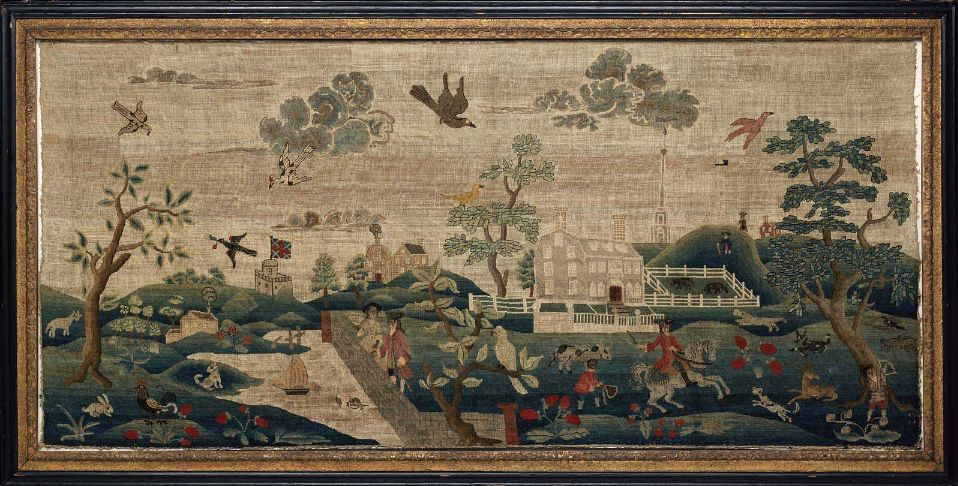
Hannah Otis’s (1732-1801) sampler “View of Boston Common” (c. 1750, Museum of Fine Arts, Boston) is a charming and significant pictorial narrative, capturing life in Boston prior to the Revolution.  The connection of the sampler to a significant New England family, the documentary nature and large over-mantel size all serve to distinguish it as a preeminent example of school girl skill and, in this case, creativity. It is embroidered in wool and silk on a linen canvas.
This sampler is a delight, and the more time one takes to examine it, the more one sees. Note the British flag waving energetically above the pre-Revolutionary blockhouse, for example. Of particular interest is the representation of the impressive Georgian style Hancock Mansion (demolished in 1863) with its fences, orchards and parterres. The elegant occupants are enjoying the bountiful and exuberant landscape, peppered with unusual birds, animals and over scaled plantings, which  Hannah Otis has created for them.  The couple standing near the wall (just to the left of center) were most likely Thomas Hancock (1703-1764) and his wife, Lydia Henchman Hancock (1714-1776), with their stately home and grounds as a backdrop. Thomas Hancock wears a long red (?) coat with substantial cuffs, a waistcoat, breeches with white hose, and what appears to be a tricorn hat. Lydia Hancock is dressed in the elite fashion of the time, sporting a light colored dress (probably silk) and stomacher.
Thomas Hancock was John Hancock’s uncle. Known as a very wealthy merchant (as well as a probable smuggler) and head of the “House of Hancock,” he opened his home and business to his orphaned nephew, John. Indeed, it would not be surprising if the lad on horseback, with a black liveried groom, depicted in Otis’s sampler was in fact the adolescent John. Born in 1737, he would have been around thirteen years of age. Like his aunt and uncle, young John wears appropriate, fashionable clothing. He is clad in riding gear, including high leather boots.


Detail, Thomas Hancock, 1730, by John Smibert
Museum of Fine Arts,  Boston
Lydia Henchman Hancock, by John Singleton Copley
National Portrait Gallery
For more, see The History Blog http://www.thehistoryblog.com/wp-content/uploads/2012/01/View-of-Boston-Common-Hannah-Otis.png
“The most expensive sampler ever sold is View of Boston Common by Hannah Otis (1732-1801), stitched around 1750. It’s a huge piece, meant for display over a chimney mantelpiece, embroidered in wool and silk on linen canvas. It was purchased by the Museum of Fine Arts, Boston at Sotheby’s in 1996 for a record $1,157,500.
Hannah Otis is closely linked to the American Revolution and American history in general. She was born in 1732, the daughter of Colonel James Otis and Mary Allyne Otis. Her mother was a descendant of Mayflower passenger Edward Doty. Her father was a judge and representative to the Massachusetts legislature. He was a fervent anti-royalist as was his son, James Otis, Jr., who introduced the phrase “Taxation without representation is tyranny” during the Stamp Act debates. Hannah’s older sister Mercy Otis Warren was a poet, playwright and historian who published numerous pro-Revolution writings and corresponded with the luminaries of the American Revolution like John Hancock, Thomas Jefferson, George Washington and John Adams.

The sampler remained in the Otis family until the 1996 sale. It had been on loan at the Boston Museum of Fine Arts for over 40 years when the family decided reluctantly that they had to sell it.”

Wednesday, March 20, 2013

John Hancock's Fashion Flourishes


the flourish of John Hancock’s (1737-1793) eponymous  signature is well-known and highly recognizable. the graceful, Restrained Luxury epitomized in John Singleton Copley’s 1765 Portrait (Museum of Fine Arts, Boston) Captures the moment before Hancock begins his political Journey. 
Together, they leave one with the image of confidence and Strength of character. John Hancock’s clothing selections, however, while not unusual for one in a position of affluence in colonial america, is perhaps less likely to fit comfortably into our impression of the American patriot or a Revolutionary, Particularly one who was actively sought out (with Samuel adams) as an enemy to BRitish colonial authority. The same may be said of many of his contemporaries who felt a disconnection between his political actions and the Fineries of his dress, his “shocking” yellow carriage, renowned largesse, love of entertainments and well-appointed beacon hill home (since demolished.)

We are fortunate that detailed Likenesses (including clothing and other accoutremonts), contemporary accounts and garments have survived and are available in the public domain.

At the Bostonian Society (www.BostonHistory.org), Hancock’s red silk Velvet jacket, c.1780s, possibly worn for his gubernatorial inauguration; at the New York Historical Society (www.nyhistory.org), an elaborately embroidered silk waistcoat, c.1780s (attributed), and, at the Lexington historical society (www.Lexingtonhistory.org), a second, simpler, waistcoat.

The Proceedings of the Bostonian Society Annual meeting, 1912 (p.41) records the following: “Court Suit. Crimson velvet body-coat, blue satin waistcoat embroidered with gold and drab silk trunks, formerly owned and worn by Governor John Hancock.” The items were given by Franklin Hancock of Haverhill, MA. 

John Hancock's (1737-1793) waistcoat (attributed), ca. 1780. The cream silk twill front panels are richly embroidered with a floral and garland motif, and bow-ties decorated with gold-painted metal sequins (spangles). As was common, There is a natural linen back panel and interior lining. Thirteen buttons covered with gold foil and gold wire serve as closures.  Gift of George Gibbs to the New York Historical Society

From the Lexington Historical Society, another silk embroidered waistcoat "worn by Gov. John Hancock." Image: digitalgallery.nypl.org 

This short piece, published late in the 19th century, gathers a number of delightful descriptions of Hancock’s garments:  

John Hancock, a character sketch, by John Roy Musick, 1898

“He seems to have been the leader of fashion--Genteel aristocrat of the day: As a young man ‘He wore a coat of scarlet, lined with silk, and embroidered with gold, white satin embroidered waist coat, dark satin small-clothes, white silk stockings, and shoes with silver buckles.’ It seems that this attire with the ‘three cornered gold laced hat constituted the gentleman of the period.’ His equipage, a coach and six blooded bays, were such as had never been seen in Boston. 

One who knew him in 1782 says: ‘He had been repeatedly and severely afflicted with gout, probably owing in part to the custom of drinking punch — a common practice in high circles in those days.’ As recollected at that time, Hancock was nearly six feet in height and of thin person, stooping a little, and apparently enfeebled by disease. His manners were very gracious, of the old style, a dignified complaisance. His face had been very handsome. ‘Dress at this time was adopted quite as much to the ornamental as the useful. Gentlemen wore wigs when abroad, and commonly caps when at home. At this time, about noon, Hancock was dressed in a red velvet cap, within which was one of fine linen. The latter was turned up over the lower edge of the velvet one, two or three inches. He wore a blue damask gown lined with silk, a white satin embroidered waist coat, black satin small clothes, white silk stockings and red morocco slippers.’ 

‘His apparel was sumptuously embroidered with gold, silver, lace and other decorations, fashionable among men of fortune of that period. He wore a scarlet coat with ruffles on his sleeves, which soon became the prevailing fashion.’  There is an anecdote told of Dr. Nathan Jacques, the famous pedestrian of West Newbury, walking all the way from that place to Boston in one day, to procure cloth for a coat like that of John Hancock, and ‘returned on foot with it under his arm.’”